Hugh Kim & Soo Yeon Chae
Since the outbreak of COVID-19 in 2019, one might wonder how we are able to use self-diagnostic kits to determine infection. The coronavirus contains antigenic proteins that are not normally found in the human body. Self-test kits that use antigen detection—one form of immunochemical diagnosis—produce a positive result when the antibodies embedded in the kit bind to coronavirus antigens like the S or N proteins in the patient’s body fluids. These coronavirus antigens can be considered biomarkers, which are indicators that signal the presence of a disease. Biomarkers are measurable indicators of changes within the body and can be proteins, DNA, metabolites, and more. For example, blood pressure is a biomarker for hypertension, blood glucose levels for diabetes, red blood cell count for anemia, and neutrophil count for neutropenia. Essentially, everything tested during medical checkups or health screenings can be considered a biomarker.
In personalized medicine, biomarkers are used for various purposes such as disease diagnosis, selection of anticancer drugs, patient risk stratification, and prognosis prediction. In breast cancer, early diagnosis is possible by detecting mutations in the BRCA1 or BRCA2 genes, and drug prescriptions can vary depending on the amplification of genes like HER2 or VEGF. For neuroblastoma—a type of pediatric cancer—personalized treatment also relies on biomarkers. For instance, patients with amplified N-myc genes or expressed MDR (multidrug resistance) genes are classified as high-risk and treated accordingly. Biomarkers like HER2, VEGF, and N-myc are discovered through genomics, proteomics, and bioinformatics research. Amplified genes cause overexpression of their corresponding proteins, leading to increased presence in tissues or cells. This can be confirmed through quantitative proteogenomic studies.
While some biomarkers are directly identified from patient samples, others are first discovered using cell models. These models use patient-derived cells or established cell lines to construct 2D or 3D cellular systems. Researchers induce specific conditions (e.g., drug resistance or angiogenesis) to identify potential biomarkers. If a biomarker identified in a cell model is also observed in actual patients, it becomes a clinically applicable biomarker. This post explores the types of cell models used for biomarker discovery in personalized medicine for cancer.
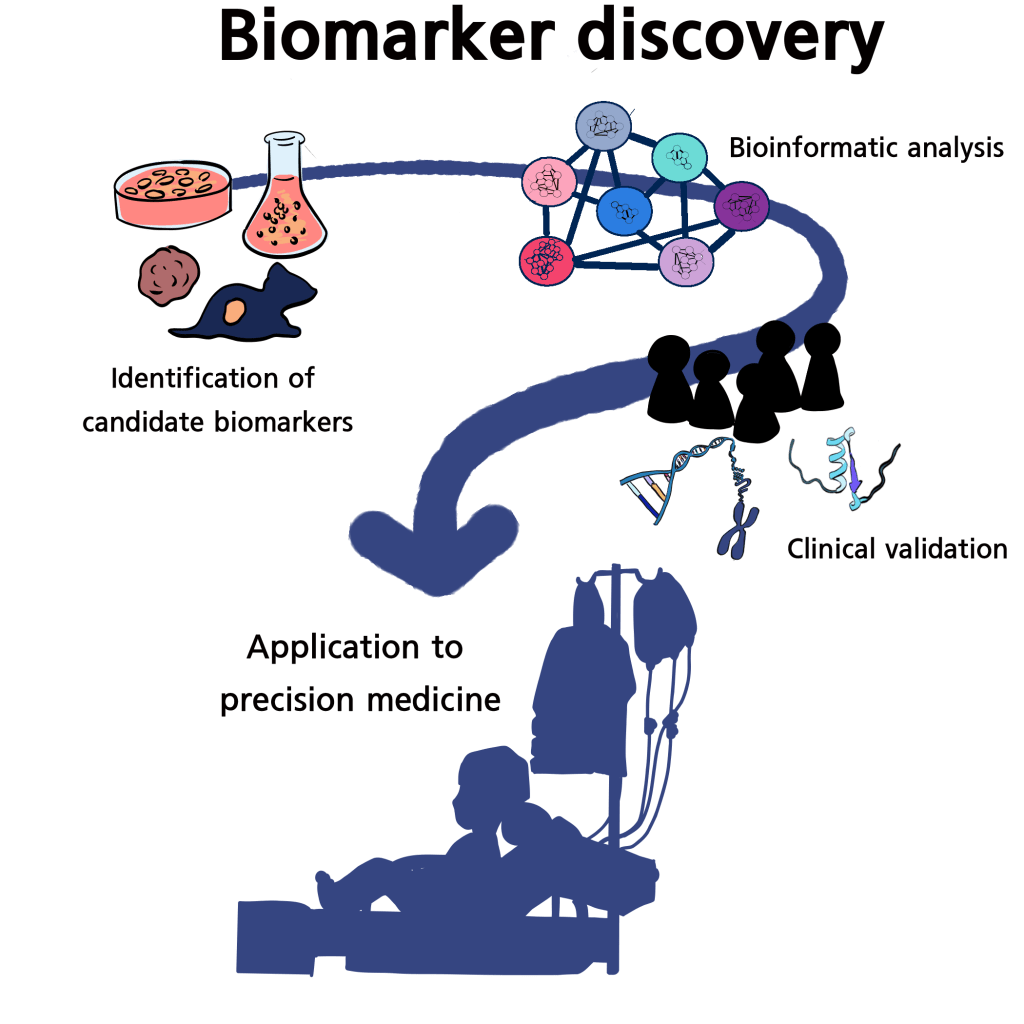
Cell models can largely be classified into 2D and 3D models.
In 2D models, cells grow as monolayers on plastic dishes or flasks coated with adhesion substances. These were the earliest models introduced and remain widely used due to their ease of culture and low cost. However, they fail to replicate the architecture of real tissues or tumors and do not allow observation of interactions between cells and the extracellular matrix. Additionally, their cellular behavior differs from that in the human body. Thus, 2D models still present limitations for discovering biomarkers for personalized therapy. To overcome these limitations, recent studies are attempting to mimic tissue architecture or nutrient distribution in tumors by combining 2D cultures with microchip technologies.
3D cell models were developed to address the shortcomings of 2D systems. These models create 3D structures from 2D cells using various culture techniques. 3D culture methods are generally divided into scaffold-free and scaffold-based approaches. In scaffold-free systems, the culture surface is treated to prevent cell adhesion, allowing cells to aggregate either in suspension or as loose clusters. In scaffold-based systems, materials like alginate, collagen, or synthetic polymers simulate the extracellular matrix, supporting 3D cell growth. Unlike 2D systems, 3D models can better mimic the complex architecture of tissues or tumors and reproduce interactions between cells and their matrix, making them more physiologically relevant.
Further advancing these models are organoids, which are engineered to closely resemble human organs or tumors in structure and function. Organoids are defined by three characteristics: self-organization, multicellularity, and functionality. Structurally 3D and composed of diverse cell types, they can replicate some organ functions. Among them, tumoroids—organoids derived from tumor tissues—are created through the differentiation, self-renewal, and organization of cancer stem cells. Because they can be derived from patient cells and cultured long-term, tumoroids have become a promising model in personalized medicine. Active research is underway to identify biomarkers through genomic and proteomic analysis of these tumoroids.
However, organoids still face limitations: they cannot replicate the full in vivo microenvironment, including immune cell interactions, and their culture techniques remain complex and costly. Researchers are gradually overcoming these challenges through co-culture systems with immune cells, microfluidic chip technology to simulate the microenvironment, and efforts to commercialize organoid culture techniques.
To effectively discover biomarkers for personalized medicine, research must be conducted using cell models that closely mimic human physiology. From 2D models to advanced 3D cultures and organoids that simulate the behavior of whole organs or tumors, a wide range of models have been developed. As these cell models evolve, we can expect personalized medicine to continue expanding in scope and clinical application.
Please visit the Hugh Kim Research Group homepage.
References
- Cliniscience, SARS-CoV-2 – Antigens (proteins and peptides) for research and development: https://www.clinisciences.com/en/buy/cat-sars-cov-2-antigens-proteins-and-5102.html
- Alan D Smith et al., J Hematol. Oncol. 2014, 7:70
- Tung, N.M., Garber, J.E., Br. J. Cancer 2018, 119, 141–152
- Bryan A.Hassell et al., Cell Rep. 2017, 508-516
- Jose M. Ayuso et al., Sci. Adv. 2021, 7, eabc2331
- P.V.Migisha Ntwali et al., TrAC 2020, 130, 116005
- Kapałczyńska, Marta et al. Arch. Med. Sci. 2018, 14, 910-919
- Lv D et al., Oncol. Lett. 2017, 14, 6999-7010
- Broutier, L., et al., Nat. Med. 2017, 23, 1424-1435


Leave a Reply