Hugh Kim & Soo Yeon Chae
When you walk into a cosmetics store, you’ll find a wide variety of products tailored for different skin types — oily, dry, combination, or sensitive skin. The same kind of personalization exists in the food industry: lactose-free milk for those lacking the enzyme to digest lactose, zero-sugar cola for diabetics, and so on. Although these are all products made for the same species — humans — they are customized because every individual is different. Differences in ethnicity, age, living environment and habits, and genetic variation all lead to the development of diverse product types.
These individual differences also appear in cancer treatment. Even when taking the same drug, patients may metabolize it differently or experience varying effects. Similarly, cancer cells themselves show heterogeneity. Solid tumors, in particular, are a prime example of this heterogeneity. Solid tumor cells continuously divide and grow, forming three-dimensional structures called tumors. The deeper inside a tumor you go, the more stressful and hostile the environment becomes for cells. To survive and continue dividing in such conditions, cancer cells may undergo genetic mutations or promote the growth of new blood vessels. These processes cause cancer cells within the same tumor to vary depending on their location and local environment.
Because there are both inter-patient differences and intratumoral heterogeneity, personalized treatment strategies tailored to each individual’s traits and response to therapy have been introduced to improve cancer treatment outcomes. In precision medicine, this approach is known as personalized therapy. For instance, if a gene or protein known to be linked to drug resistance is identified, a patient’s genome or proteome can be analyzed to check whether their cancer cells are resistant to a specific drug. Alternatively, if a cancer cell expresses a particular target molecule, targeted therapy can be applied.
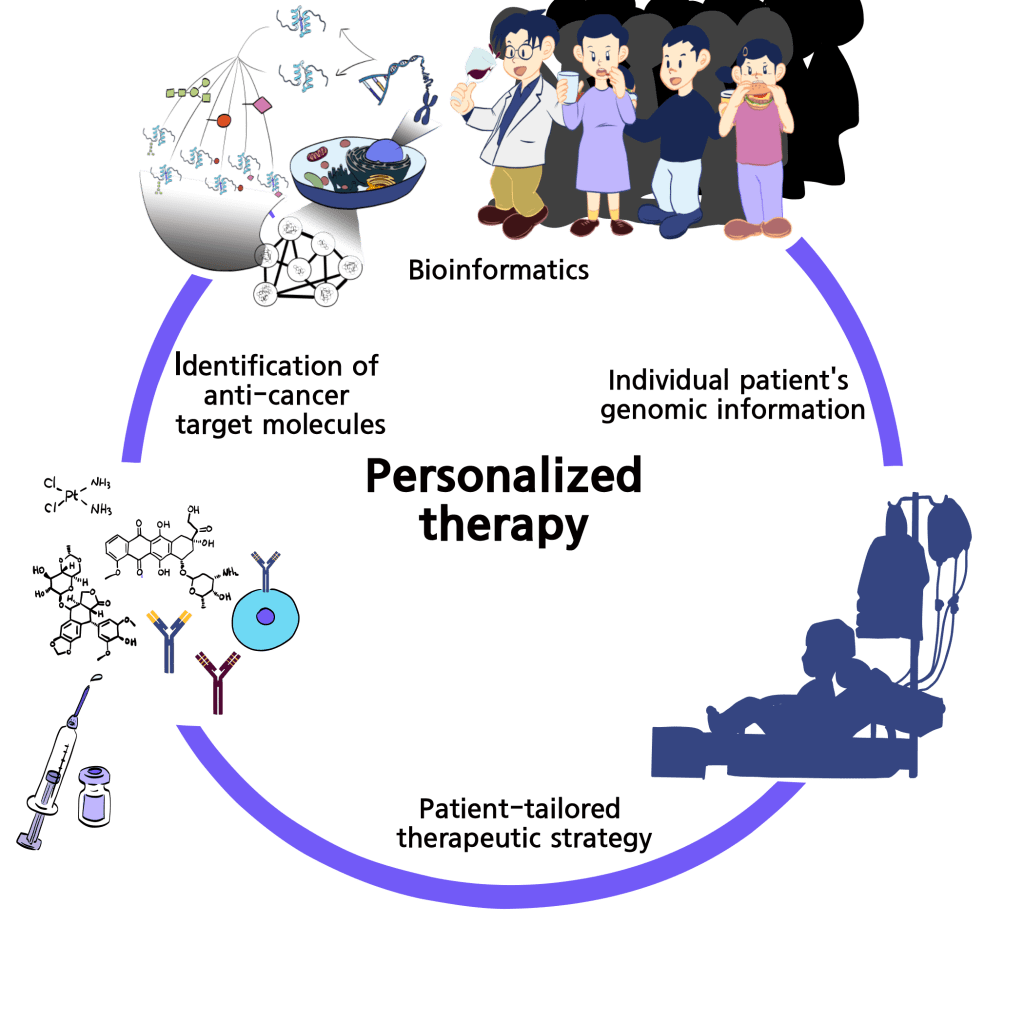
In personalized treatment, it is crucial to extract useful information from the vast datasets generated by genomic and proteomic analyses. The field of study that handles this task is called bioinformatics. It deals with large-scale biological data such as DNA and protein sequences, the structure and function of proteins, and the development and management of biological databases. Bioinformatics enables the identification of drug targets in cancer therapy, classification of tumors based on genetic profiles, and the foundation of better medical care and treatments.
Researchers around the world are working to build bioinformatics databases, many of which are publicly available. One example is the Cancer Cell Line Encyclopedia (CCLE), a collaboration between the Broad Institute and the Novartis Institutes for BioMedical Research, which systematically characterizes the molecular features of various cancer cell lines and has significantly contributed to the development of bioinformatics. Research using the CCLE is being conducted to develop personalized cancer therapies based on the genetic markers associated with drug sensitivity. Another project, ENCODE (Encyclopedia of DNA Elements), focuses on understanding the function of DNA sequences identified through the Human Genome Project, and determining which DNA elements are involved in disease.
In the United States, large-scale initiatives like The Cancer Genome Atlas (TCGA) and the Clinical Proteomic Tumor Analysis Consortium (CPTAC) are leading efforts to integrate genomic, proteomic, and bioinformatics approaches. These programs aim to classify tumors more precisely, identify novel therapeutic targets, and support the development of personalized cancer treatments based on individual genetic and molecular profiles.
In South Korea, researchers are also integrating proteogenomics and bioinformatics to classify tumors and identify functional elements based on genetic variations. For example, collaborative studies between Korea University’s Proteogenomics Research Center and the Korean National Cancer Center have focused on identifying mutation genes associated with early-onset gastric cancer and classifying its molecular subtypes.
Although research in proteogenomics and bioinformatics has greatly advanced personalized treatment, there are still barriers to overcome. These include the high costs of analysis and the challenges of translating academic findings into clinical applications. However, ongoing efforts to simplify analyses, reduce costs, and conduct prognostic studies in real patients are helping to accelerate the integration of bioinformatics-based therapies into real-world medical systems. Many experts are optimistic that these obstacles will soon be overcome.
Please visit the Hugh Kim Research Group homepage.
Referenes
- Junttila MR et al., Nature. 2013; 501, 346–354.
- Jordi Barretina et al., Nature 2012, 483, 603–607.
- Dunham, I. et al., Nature 2012, 489(7414), 57–74.
- Dong-Gi Mun et al., Cancer Cell 2019, 35, 111–124.
- Chae S.Y. et al., iScience 2021, 24, 102325.
- OpenAI. (2025). ChatGPT (April 21 version) [Large language model]. https://chat.openai.com/
 Leo & Leah
Leave a comment