
Hugh Kim & Dongjoon Im
There are various criteria for classifying proteins, such as function, physical properties, distribution, and concentration in the body. From a structural perspective, proteins can broadly be categorized into structured proteins and intrinsically disordered proteins (IDPs). Structured proteins form specific three-dimensional structures through defined pathways, with secondary to quaternary structures that are stable and identifiable. Most proteins we commonly know are structured proteins. Intrinsically disordered proteins, as the name suggests, do not have a fixed structure. IDPs inherently have regions that are disordered and cannot be defined structurally, accounting for about 30% of human proteins. A peptide or an entire protein can be disordered (IDP), or specific regions within the protein can be intrinsically disordered (intrinsically disordered regions).
The main characteristic of intrinsically disordered proteins is that they do not spontaneously fold into a defined single three-dimensional structure, but instead fluctuate among various conformations. Typically, proteins fold into stable structures, which allow them to interact with other biomolecules and perform their functions in the body. Understanding the folding and function of intrinsically disordered proteins remains a challenging area of research. Because IDPs cannot be easily characterized by traditional structural biology methods, new techniques are continuously being explored to study their structure and behavior. In this section, we will briefly introduce intrinsically disordered proteins and methods to analyze them.
Why do intrinsically disordered proteins lack a unique structure? The building blocks of proteins, amino acids, consist of an amine group, a carboxyl group, and a unique side chain that determines the specific type of amino acid. Among the 20 amino acids that make up biological proteins, glycine is small and has limited interaction potential with other amino acids. Due to its small size and low interaction frequency, the formation of a stable structure is less likely, making the environment around it more flexible. In contrast, proline has a unique structure with its amine group and side chain connected, which significantly limits the steric flexibility within the molecule. For a protein to form a three-dimensional structure, local interactions between the amino acids in the polypeptide chain lead to the formation of secondary structures like alpha-helices and beta-pleated sheets. However, glycine, being very small, and proline, with restricted steric flexibility, hinder the formation of secondary structures for different reasons. Likewise, the other 18 amino acids have varying side chains, and each one influences protein structure formation in unique ways. Some amino acid sequences or combinations are statistically more likely to form specific types of secondary structures, known as structural motifs. On the other hand, some amino acids do not have a strong preference for any particular structure, making it more difficult for the protein to fold into a stable structure. Intrinsically disordered proteins lack such stable structures and continuously change shape within a similar energy state, which is why they do not have a fixed conformation.
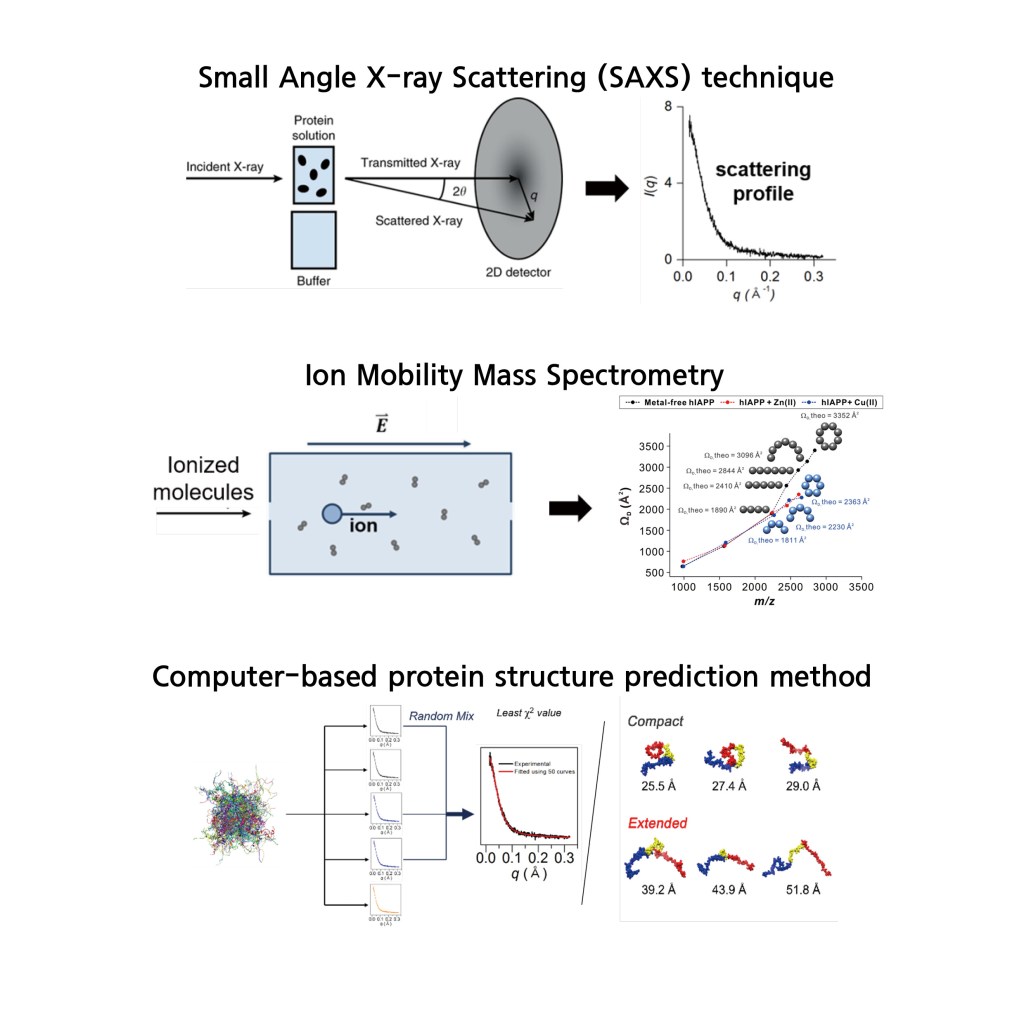
It may seem paradoxical that intrinsically disordered proteins can still have a structure despite not having a unique one. For example, when analyzing proteins that include disordered regions using X-ray crystallography, which is a representative method in structural determination, the disordered regions appear as diffuse electron density distributions in multiple locations, making it impossible to assign a specific structure. Cryo-electron microscopy, which significantly advanced the determination of protein structures, faces a similar challenge when analyzing intrinsically disordered proteins. However, while intrinsically disordered proteins do not have a fixed structure, they surely exist in some conformation. Analyzing the structure of intrinsically disordered proteins means obtaining information about the various conformations or ensemble of structures that they can adopt. Nuclear magnetic resonance (NMR) spectroscopy is an excellent tool for determining various structures of intrinsically disordered proteins, although there is a limitation regarding the size of the protein molecules that can be analyzed. One suitable method for analyzing the three-dimensional structure of such flexible proteins is small-angle X-ray scattering (SAXS).
The SAXS technique was originally developed to observe the structural transitions and overall shape of biomolecules in aqueous solutions. For proteins with a stable, unique structure, low resolution can be a drawback in 3D structure analysis, but for intrinsically disordered proteins, it provides valuable insights. SAXS experiments can provide information on the molecular weight, volume, and size of biomolecules. Moreover, it can give information about the flexibility and folding of the protein. Thus, SAXS can determine the distribution and average of the 3D structures of an intrinsically disordered protein in solution, where the protein may exist in multiple forms. Like other structural determination techniques, SAXS can result in complex data when analyzing intrinsically disordered proteins because the resulting data reflect various structural states. However, interpreting the results can yield valuable information if we recognize that the data are a combination of multiple structural possibilities. This is known as ensemble optimization method (EOM). In this method, the SAXS prediction for each structural candidate of the protein, based on its amino acid sequence, is compared with experimental measurements to interpret the SAXS patterns. One advantage of this technique is that it allows the analysis of proteins in solution, without the need for crystallization or cooling, unlike other methods.
Analyzing the quaternary structure of intrinsically disordered proteins that form complexes remains a challenging research area. As mentioned earlier, some intrinsically disordered proteins have a strong tendency to form aggregates and can exist in a form where multiple IDP molecules are bound together. If these aggregates grow large enough to lose their flexibility and stabilize into one structure, cryo-electron microscopy can be very effective for structural determination. However, before forming such large aggregates, there may be multiple stages, and mass spectrometry can be used to elucidate the quaternary structure formed by early interactions between IDPs. There was a debate about whether protein complexes observed through mass spectrometry, which requires the removal of solvents, were present in solution or formed during the measurement process. However, it is difficult to explain the formation of a quaternary structure in the absence of water when such interactions between disordered proteins are unlikely to be strong enough to create stable quaternary structures outside of an aqueous environment. Thus, it is essential to establish experimental conditions that do not significantly disrupt the protein’s native structure when using mass spectrometry to analyze quaternary structures. Using mass spectrometry, various initial protein complexes of different sizes can be observed, and combining this with ion mobility spectrometry provides both information about the composition of the complexes and their structures.
While methods for analyzing intrinsically disordered proteins experimentally still lag behind those for structured proteins, it is possible to analyze their structural ensembles. In fact, structured and intrinsically disordered proteins are not strictly separated. Some structured proteins contain disordered regions (IDRs), and the proportion of disordered regions varies greatly among different types of proteins. Therefore, integrating the tools best suited for analyzing structured proteins with those suitable for proteins with uncertain structures, through interdisciplinary collaboration, will enable more accurate structural determinations. Moreover, combining computational methods for protein structure prediction with a long-established understanding of water-protein interactions will enhance the reliability of structural analysis. Understanding the structures of intrinsically disordered proteins is challenging, but they play a vital role in biological processes and are closely related to various diseases, so all available technologies must be employed to solve issues related to IDPs.
Please visit the Hugh Kim Research Group homepage.
References
- Patterson, C. World Alzheimer report 2018, 2018
- Chou, P. Y., and Fasman, G. D. Biochemistry 1974, 13 (2), 222-245
- Guinier, A. In Annales de physique 1939, 11 (12), 161-237
- Perez, J. et al. J Mol Biol 2001, 308 (4), 721-743
- Jensen, M. R., et al. Structure 2009, 17 (9), 1169-1185
- Kikhney, A. G., and Svergun, D. I. FEBS lett 2015, 589 (19), 2570-2577
- Han, J. Y., et al. Mass Spectrom Rev 2019, 38 (6), 483-500
- Seo, J., et al. Nat Chem 2017, 9 (1), 39-44
- Bleiholder, C., et al. J Am Chem Soc 2013, 135 (45), 16926-16937; Young, L. M., et al. Nat Chem 2015, 7 (1), 73-81; Zheng, X., et al. J Phys Chem B 2015, 119 (14), 4831-4841
 Leo & Leah
Leave a comment