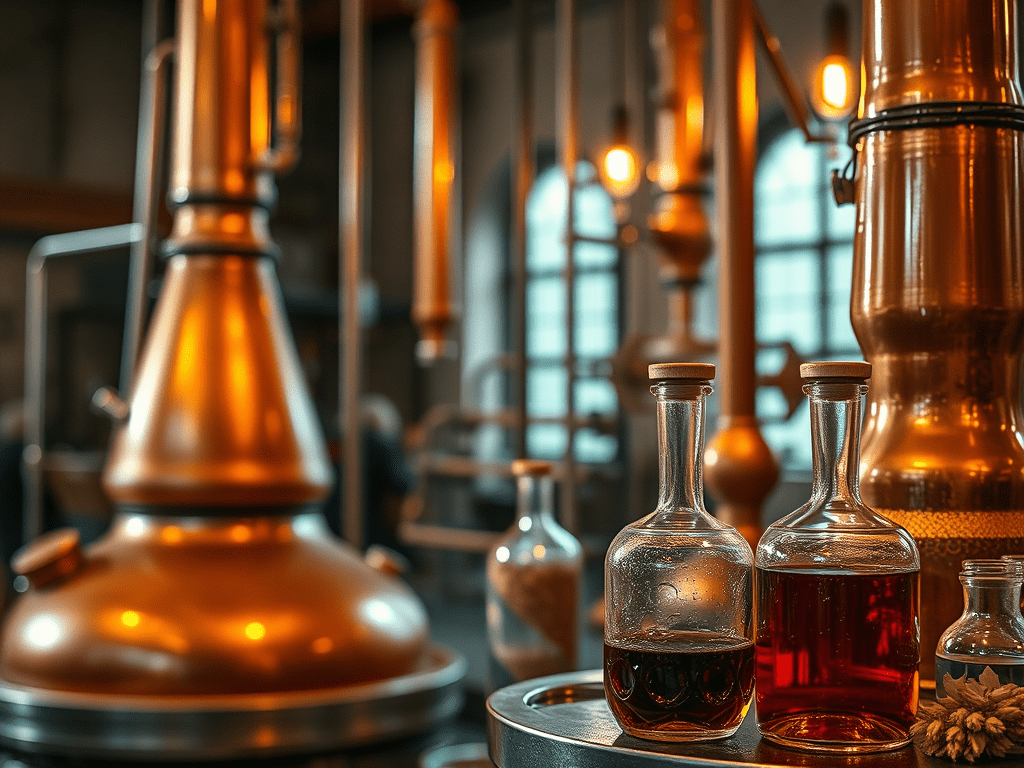
As a scholar, I understand chemistry as the study of substances at the molecular level, aiming to comprehend and modify them. From this perspective, distilled spirits represent the chemical pinnacle of alcoholic beverages. Fermented beverages are produced through the metabolism of sugars by microorganisms (yeasts), resulting in ethanol. These drinks, including various beers, wines, sake, and rice wines, contain not only ethanol but also numerous other compounds derived from the raw materials (rice, barley, grapes, etc.) and the yeast’s metabolic processes, giving each beverage its unique flavor and aroma. Over time, different fermentation techniques evolved across cultures, leading to a diverse array of fermented beverages.
Historically, human involvement in altering the properties of alcoholic beverages was rather passive, limited to fermentation processes. However, as humanity began to understand the mechanisms behind these processes, they started actively intervening by adding hops to beer, aging wine in oak barrels, and polishing rice for sake. This marked the beginning of more direct human control over the chemical reactions in alcoholic beverages. The advent of distillation and extraction, the two primary methods of chemical separation, allowed for precise control over the content of ethanol and aromatic compounds in beverages. It’s no exaggeration to say that the development of distilled spirits, dating back to 2,000 BCE, was a significant milestone in the history of alcohol.
Distilled spirits are produced by separating ethanol from water in fermented beverages through distillation. Water and ethanol mix well due to hydrogen bonding, and their boiling point depends on their ratio. When heated to boiling, the solution evaporates, with ethanol (boiling point 173°F) present in a higher proportion in the vapor phase than water (boiling point 212°F). By condensing this vapor in a cooler tube, a solution with a higher ethanol content is obtained. For example, a solution with 5% ethanol starts to boil at around 205°F, and the resulting vapor contains approximately 40% ethanol and 60% water. By cooling this vapor to below 185°F, it condenses into a solution with 40% ethanol. Repeated vaporization and condensation can further increase the ethanol content. However, due to ethanol’s strong affinity with water through hydrogen bonding, it cannot be distilled beyond 95.6% purity, as at this concentration, the vapor and liquid phases maintain the same ratio.
Distillation also removes nearly all non-volatile carbohydrates and proteins from the fermented beverage, leaving behind some volatile compounds responsible for the unique flavors and aromas. While some distilled spirits undergo aging, most are filtered and sold without additional aging. Nonetheless, volatile compounds formed during fermentation, such as esters, are retained, contributing to the distinctive taste of the distilled beverage.
Distilled spirits contain high levels of ethanol, a substance that mixes well with both polar and non-polar molecules, enabling it to dissolve a variety of aromatic compounds. This high ethanol content enhances the beverage’s aroma, as more aromatic molecules can be dissolved. Oak, known for its aromatic compounds discovered through wine aging, can infuse even more flavors into spirits with high ethanol content. Using oak barrels that previously aged wine adds unique molecular residues to the distilled spirit.

Whiskey, a leading distilled spirit, is made by distilling a base wine fermented from malted barley and grains. Unlike beer, hops are not added during brewing. If only malt is used, it is called malt whiskey; if mixed with grain whiskey, it is called blended whiskey; and if made using malt whiskey from a single distillery, it is called single malt whiskey. Whiskey is aged in oak barrels for at least three years, during which the initial ethanol content of about 70% decreases to 55 – 65% due to evaporation. The lost ethanol is replaced by compounds like whiskey lactone (imparting coconut and woody flavors) and vanillin (imparting vanilla flavor), which interact with smoky compounds like guaiacol from the malt fermentation process, creating whiskey’s distinctive taste and aroma.
Over time, these aromatic compounds increase relative to the ethanol, enhancing the complexity of the flavor. The burning sensation of whiskey comes from ethanol evaporating on the mucous membranes, cooling the surface and releasing aromatic compounds detectable by the olfactory receptors. However, this effect diminishes after a couple of drinks, as further consumption numbs the senses, diminishing the perception of both ethanol and aroma. Therefore, starting with expensive, high-quality whiskey is advisable, but there’s no need to maintain this quality throughout the drinking session. Experts recommend diluting whiskey with water to around 20% ethanol to slow intoxication, allowing the aromas to be appreciated longer.
Brandy, exemplified by cognac, is made by distilling wine and aging it in oak barrels. It retains the tannins, polyphenols, esters, and organic acids of the original wine but in different proportions. Unlike wine, brandy has a higher ratio of acetic acid (vinegar component) and furan compounds like furfural. The chemical reactions during distillation alter many of the wine’s compounds, resulting in brandy’s unique profile. Cognac, distilled twice, contains more furan compounds than single-distilled brandy.
There are many types of alcoholic beverages, each intricately linked with human culture and chemistry. While fascinating from a scientific perspective, it’s essential to remember the risks associated with alcohol consumption. In the USA, 10 – 12% of deaths are related to alcohol, with about 80% due to alcohol-related diseases. Chronic heavy drinking increases the risk of various cancers, alcoholic cardiomyopathy, arrhythmias, hypertension, cerebrovascular disease, hyperlipidemia, pancreatitis, gastritis, alcoholic liver disease, neurological disorders, and fetal alcohol syndrome. Clinical institutions advise drinking slowly and in moderation, allowing the liver 2 – 3 days of rest after drinking to recover.
References
- Mysels, J. Opioid Manag. 2010 6, 445
- https://www.chemsafetypro.com/Topics/CRA/acute_toxicity_ld50_lc50.html
- https://www.therecoveryvillage.com/alcohol-abuse/
- Chiara, Alcohol Health Res. World. 1997, 21, 108
- Cervera-Juanes et al. Mol Psychiatry. 2016, 21, 472
- https://www.drugabuse.gov/drug-topics/alcohol
- Palmer, (2017) How To Brew: Everything You Need to Know to Brew Great Beer Every Time, 4th Ed., Brewers Publications
- Hornsey, (2003) A History of Beer and Brewing, Royal Society of Chemistry
- Olaniran et al. J. Inst. Brew. 2017, 123, 13
- Devitt, 500 years ago, yeast’s epic journey gave rise to lager beer, https://news.wisc.edu/. 2011. 08. 22.
- Stack, A Concise History of America’s Brewing Industry, EH.net
- Gajanan, How to Talk About Beer Like a Pro, Time, 2018. 04. 07
- https://beerandbrewing.com/dictionary/tUHp3R5egg/
- Ting & Ryder, J. Am. Soc. Brew, Chem., 2017, 75, 161
- BYO Staff, Using Roasted Barley: Tips from the Pros, byo.com, 2004. 01
- https://www.simpsonsmalt.co.uk/blog/malt-production-process-roasting/
- Carlin and Rosentha, (1998) Food and eating in medieval Europe, Hambledon Press
- Mitchell and Herlong, Annu. Rev. Nutr., 1986, 6, 457
- Zelman, The Truth About Beer, webMD, 2014. 08.
- Hobson and Maughan, Alcohol Alcohol., 2010, 45, 366
- Cuzzo and Lappin, Vasopressin (Antidiuretic Hormone, ADH), StatPearls [Internet], 2019
- Chiba and Phillips, Addict. Biol, 2000, 5, 117
- Fugelsang and Edwards, (2010) Wine Microbiology, 2nd Ed., Springer Science and Business Media
- Adams, The Science of Winemaking Yeasts, Sevenfiftydaily, 2018. 06. 06.
- Remize et al. Yeast, 2003, 20, 1243
- Russan, The Science of Tannins in Wind, SevenFiftyDaily, 2019. 02. 07.
- Rovner, C&En, 2006, 84, 30
- Robles et al. TrAC-Trends Analyt. Chem., 2019, 120, 115630
- Hines, These Are the Chemical Compounds That Make Wine Taste So Good, Vinepair, 2017. 09. 24.
- Corliss, Is red wine actually good for your heart?, Harvard Healthy Blog, 2018. 02. 19.
- Panesar (2014) Biotechnology in Agriculture and Food Processing: Opportunities and Challenges, CRC Press
- Bang et al. Korean J. Food Cook Sci., 2016, 32, 44
- Takahashi & Kohno, PLos One, 2016, 11, e0150524
- https://en.sake-times.com/learn/the-science-of-sake-aroma
- https://thesool.com
- Casey & Ingledew, Crit. Rev. Microbiol., 1986, 13, 219
- Jin et al. Trends Food Sci. Technol. 2017, 53, 18
- Karlsson & Friedman, Sci. Rep., 2017, 7, 6489
- Tsakiris et al. J Sci Food Agric 2014; 94: 404
- http://www.snuh.org/health/compreDis/OT01/6.do

 Leo & Leah
Leave a reply to The Fine Line Between Good and Bad Fats – Leo & Leah Cancel reply