
Hugh Kim & Dongjoon Im
When I was in my teens and twenties, now in my late 40s, multiplex cinemas weren’t as common as they are today. To watch a popular movie, you often had to wait for hours in long lines leading to the box office, and it was incredibly difficult to get tickets for the desired time slot. One of the movies I managed to watch after such an ordeal, meeting friends at dawn on a weekend and waiting for hours, was Back to the Future Part II. It depicted the “future city of 2015,” which, as of 2024, has become the past. The film featured hoverboards and Nike shoes that automatically adjusted to fit your feet—both of which left a strong impression (though I honestly don’t remember much of the plot). The lead actor, Michael J. Fox, was once a major Hollywood star, but he suddenly disappeared from the spotlight.
Years later, I encountered his name again, not as an actor, but as the name of a research foundation. Michael J. Fox was diagnosed with Parkinson’s disease (PD) in 1991 and quietly battled the illness until his symptoms worsened, leading him to retire from acting in 2000. The global movie star then founded the Michael J. Fox Foundation, which supports research to combat Parkinson’s disease. Today, the foundation is actively collaborating with various institutions worldwide to develop treatments and conduct research on Parkinson’s disease. For researchers, having such an institution leading the charge against a specific disease is incredibly encouraging. However, the fact that there is significant interest and active research in this field also means the disease is relatively common. After Alzheimer’s disease (AD), Parkinson’s disease is the second most prevalent degenerative neurological disorder. But how much do we know about it?
Parkinson’s disease is characterized by motor disorders such as muscle rigidity, tremors, and slowed movements. However, its cause lies not in the muscles or bones but in the death of dopamine-producing neurons in the substantia nigra of the midbrain. Like Alzheimer’s, Parkinson’s is considered a representative degenerative neurological disorder. It affects approximately 1–2 out of every 1,000 people and is classified as an age-related disease, raising concerns in aging societies such as Japan, Italy, Germany, South Korea, Spain, and France, among others. The exact mechanisms behind the degeneration of substantia nigra neurons remain unclear, and there is no cure targeting the underlying cause. While genetic factors may play a role, most cases occur without a family history. The environmental and lifestyle factors contributing to the disease are also uncertain. Diseases with unknown causes, like Parkinson’s, are called idiopathic diseases, and Parkinson’s disease is predominantly idiopathic. Despite the many unknowns, significant research is ongoing to uncover its causes and progression.
Alpha-synuclein (α-synuclein) is a key protein associated with Parkinson’s disease. Pathological hallmarks of Parkinson’s include the accumulation and aggregation of α-synuclein in Lewy bodies and Lewy neurites found in brain lesions. Similar to amyloid-beta or tau proteins, α-synuclein is an intrinsically disordered protein that can form amyloid fibrils. It is presumed to play a specific role in neurotransmission. The first link between Parkinson’s and α-synuclein was identified through genetic variations leading to the disease. Although the genetic causes account for a small proportion of Parkinson’s cases, they are significant because they provide clear insights through genetic studies. The SNCA gene, which encodes α-synuclein, is at the center of these findings. A study published in 1997 reported cases of Parkinson’s disease linked to point mutations in the SNCA gene among Italian and Greek families. These cases often involved early-onset Parkinson’s, manifesting in the 40s. Additionally, gene duplication or triplication of the SNCA gene, leading to increased alpha-synuclein production, has been identified as another hereditary form of Parkinson’s.
Interestingly, SNCA gene variations are also associated with idiopathic Parkinson’s. While the exact triggers for these mutations remain unknown, specific mutations in the SNCA gene are linked to Parkinson’s onset. These connections have been validated through genome-wide association studies (GWAS), which analyze the genetic associations of diseases.
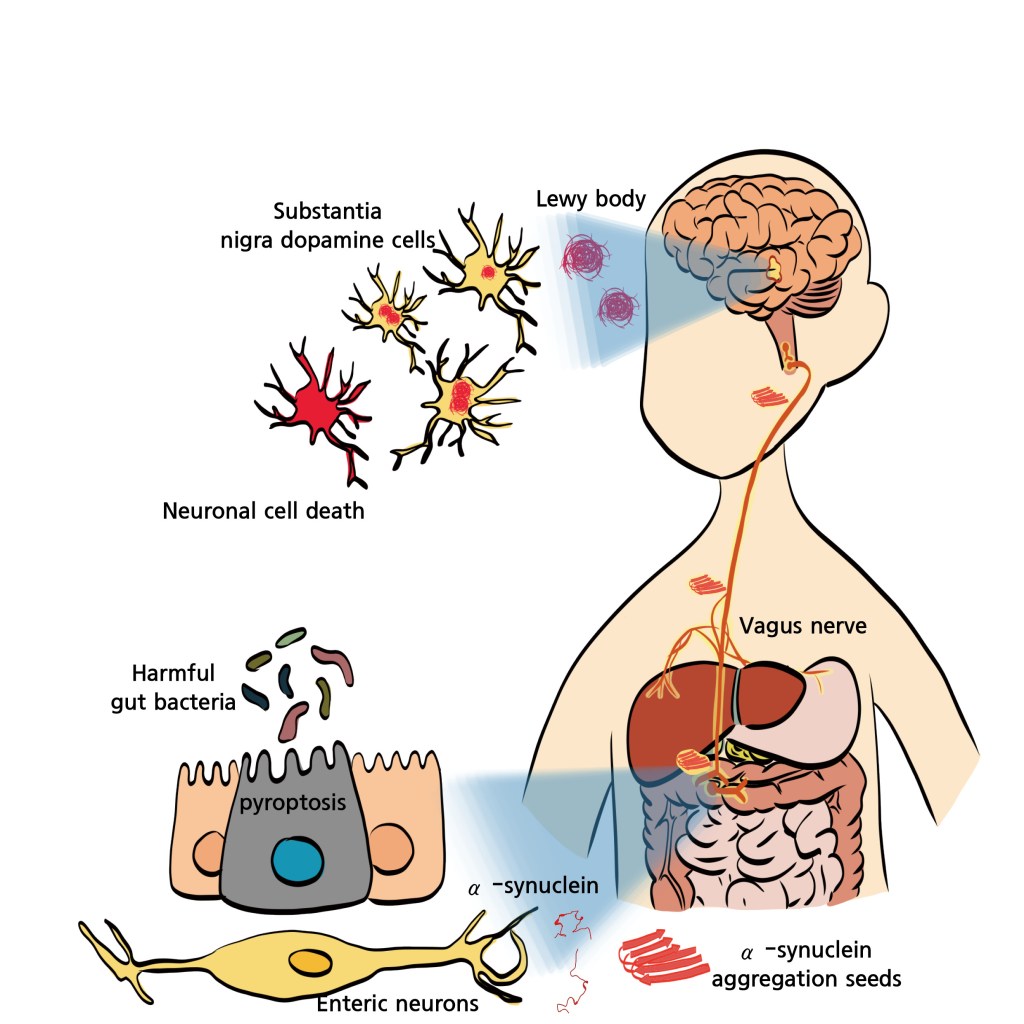
Overall, it is evident that the abnormal aggregation of α-synuclein is closely related to the development of Parkinson’s disease. However, whether these aggregates and their accumulation are the primary drivers or secondary effects of the disease remains uncertain. Research has shown that (1) mutations and overexpression of α-synuclein caused by genetic variations are linked to Parkinson’s onset, (2) α-synuclein aggregates are widely distributed across various brain regions, and (3) α-synuclein aggregation is associated not only with Parkinson’s but also with other neurodegenerative disorders collectively termed synucleinopathies.
Although α-synuclein is an intracellular protein, recent studies have revealed that it is also secreted outside cells. While the pathways through which it is secreted remain unclear, it is detectable in bodily fluids like plasma and cerebrospinal fluid. Research has shown that extracellular α-synuclein, particularly oligomers, can be toxic to neurons. Notably, α-synuclein secreted from the enteric nervous system may form aggregation seeds, which could travel to the brain and trigger Parkinson’s. The enteric nervous system, often referred to as the “second brain,” governs gastrointestinal functions. About 60-80% of Parkinson’s patients experience gastrointestinal issues. Various studies have found that conditions such as an imbalanced gut microbiome, viral infections, or inflammation can increase α-synuclein levels in the gut. In animal studies, injecting preformed α-synuclein aggregates into the duodenal and pyloric muscle layers led to the detection of aggregates in the dorsal motor nucleus of the vagus within a month, followed by spread to the amygdala and substantia nigra. These findings suggest that excessive alpha-synuclein secreted from the gut may contribute to Parkinson’s development.
These studies point to removing α-synuclein or neutralizing its aggregates as a rational therapeutic approach for Parkinson’s and other synucleinopathies. However, given α-synuclein’s role in neurotransmission, such strategies may have neurotoxic side effects. Like Alzheimer’s research, Parkinson’s treatment development must leverage an advanced understanding of α-synuclein at the molecular level, ensuring that interventions do not disrupt its normal functions.
References
- Stolzenberg, E., et al. J Innate Immun 2017, 9(5), 456-463
- Olivera, L., et al. NPJ Parkinsons Dis 2021, 7(1), 1-23
- Olivera, L., et al. Cell Death Dis 2015, 6(11), e1994
- Stefanis, L. Cold Spring Harb Perspect 2012, 2(2), a009399
- Kim, S., et al. Neuron 2019, 103(4), 627-641
- Sampson, T. R., et al. Cell 2016, 167(6), 1469-1480
- Challis, C., et al. Nat Neurosci 2020, 23(3), 327-336
 Leo & Leah
Leave a comment