
As mentioned in the previous post Everything We Eat is Science, during my college years, when I had no money or degree but was always short on time, I often grabbed lunch at the “Happy Place” (a fast-food chain slogan) and ate it while walking to class. Especially on Thursdays, the flagship burger, featuring “two all-beef patties, special sauce, lettuce, cheese, pickles, onions on a sesame seed bun,” was only 99 cents, making it a staple. Other burgers were also discounted to under a dollar daily. Eating these, I noticed the nutritional information on the packaging. Each burger contained just over 500 kcal, which seemed surprisingly low, while the fries that came with the set had over 300 kcal, and the total set, including the soda, neared 1,000 kcal.
In an attempt to be healthier, I opted for just the burger without fries and chose zero-calorie soda. I thought this was a smart way to save money, avoid gaining weight, and eat quickly. However, while I didn’t gain weight, my health deteriorated. A blood test after donating blood near campus revealed shocking results. Unlike my excellent results from frequent blood donations during military service, after just two years in the US, my triglyceride and cholesterol levels (LDL and HDL) were abnormal.
Why did this happen despite avoiding fries and controlling calories? A single burger contains about 30g of fat, including around 11g of saturated fat. While I knew saturated fat was unhealthy, a burger like this provided only 73% of the daily recommended intake of saturated fat. So why did my triglyceride and cholesterol levels worsen? Was it due to my other meals? Breakfast usually consisted of cereal with low-fat milk, and dinner was balanced meals at the dormitory dining hall. Even now, I can’t pinpoint the exact problem, but let’s explore based on current research.
Fats are highly efficient molecules for energy storage, primarily stored and utilized as triglycerides in the body, though they also exist as fatty acids and various hydrocarbon chains. All these forms are hydrocarbon-based structures. Fossil fuels, our primary energy source since the 18th-century industrial revolution, are also hydrocarbon-based.
Hydrocarbons are compounds with carbon atoms bonded to other carbon or hydrogen atoms, each bond containing about 100 kcal/mol of energy. Although the bond energy varies, this approximation is sufficient. Consequently, proteins and carbohydrates provide 4 kcal per gram, while fats, rich in hydrocarbons, offer 9 kcal per gram. This high-calorie content makes fats ideal for energy storage in the body. As one of the three major nutrients, fats, along with fat-soluble vitamins and essential fatty acids, are vital for life, forming cell membranes and organelles, synthesizing various hormones, and playing crucial roles in brain and nerve functions.
The World Health Organization (WHO) recommends that fat intake should be less than 30% of daily calorie intake. For adults consuming 2,000 – 2,500 kcal per day, this translates to 66 – 83 g of fat. However, since 2015, the US Department of Health and Human Services has not set a limit on daily fat intake, reflecting a significant shift in our understanding of fats. Previously, fats were considered the enemy of health, linked to obesity and various adult diseases, leading to recommended daily limits. Now, it is understood that not all fats are harmful, but distinguishing between healthy and unhealthy fats remains nuanced.
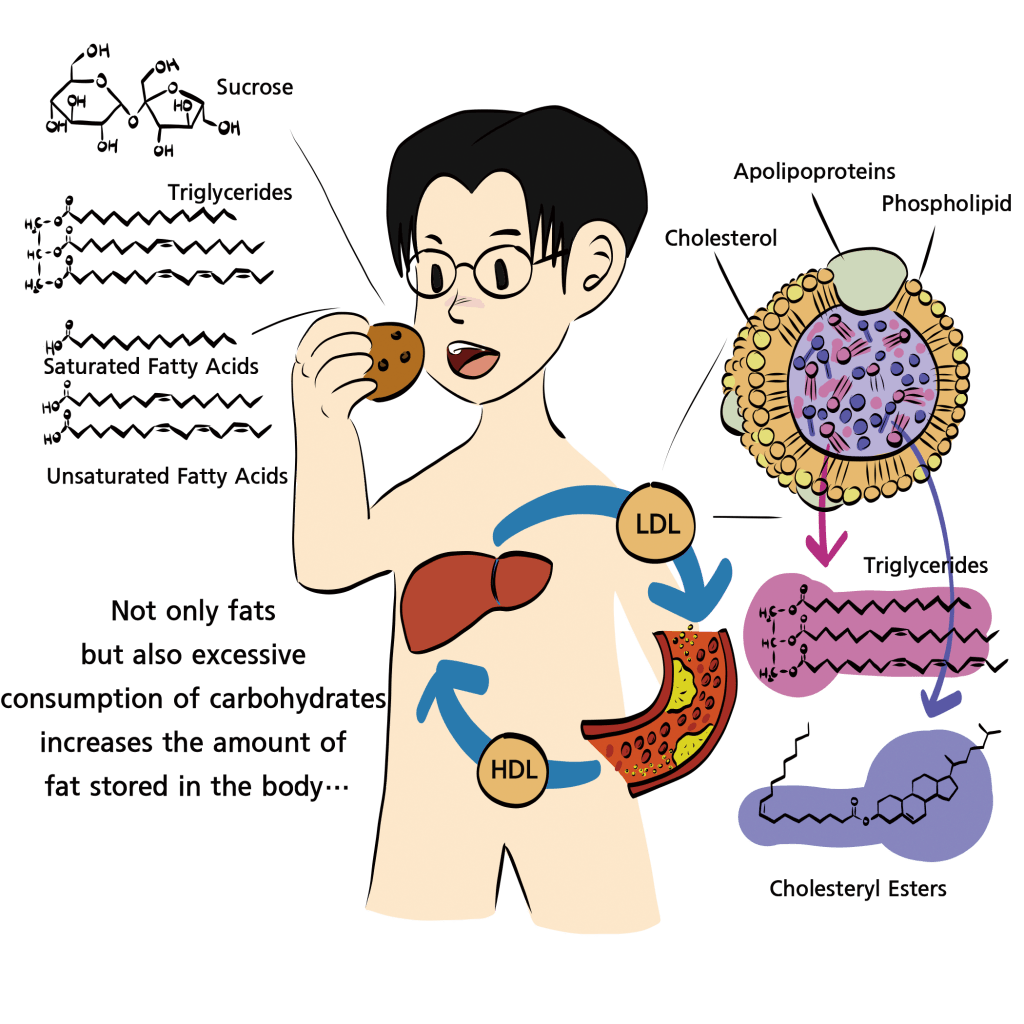
The primary form of fat used in the body is triglycerides, stored in lipoproteins that travel through the bloodstream, supplying energy to cells. Lipoproteins, complexes mainly delivering cholesterol, are classified into five types based on size. Simply put, low-density lipoproteins (LDL) are fat-rich and low-density, while high-density lipoproteins (HDL) are fat-poor and high-density.
LDL delivers fats to cells, while HDL absorbs excess fats and transports them to the liver. Excess fats not used by cells are stored in fat cells, leading to weight gain. Consuming more fats than the body needs results in weight gain. However, fats alone are not the problem. Cells use ATP as their ultimate energy source, derived not only from fats but also from glucose, a hydrocarbon-based molecule used immediately for energy. Excess glucose is stored as glycogen in muscles or the liver and eventually converted to fat for storage. Alcohol consumption, while not directly converted to fat, promotes triglyceride synthesis. Thus, the problem lies in excessive food intake, not just fat consumption.
Triglycerides consist of three fatty acids (hydrocarbon chains) attached to a glycerol backbone. Fatty acids with only single bonds between carbon atoms are called saturated fats, while those with double bonds are called unsaturated fats. Saturated fats, abundant in animal fats and palm oil, have melting points ranging from 43 – 69°C, meaning they exist as solids at room and body temperature. High intake of saturated fats increases their proportion in triglycerides, disrupting LDL formation and activation in the liver, thus raising LDL levels.
LDL rich in saturated fats easily oxidizes in the bloodstream, causing inflammation and plaque formation in blood vessels, leading to cardiovascular diseases. Therefore, WHO and other institutions recommend that saturated fat intake should be less than 10% of total daily caloric intake. However, as discussed in “The Impact of Milk Fat on Health: Debunking Myths and Misconceptions“, some studies suggest that dairy fat, which is over 60% saturated fat, is not linked to obesity or cardiovascular diseases, contradicting the idea that all saturated fats are harmful. Similarly, there is no significant correlation between meat consumption and cardiovascular diseases, indicating that factors beyond just saturated fat intake influence these conditions.
In contrast, unsaturated fats are considered healthy. What actions do unsaturated fats take in the body to earn this reputation? Trans fats, another type of unsaturated fat, are structural isomers of the healthy cis unsaturated fats. What causes this structural difference, and why are trans fats harmful? The mystery of my rising cholesterol levels despite calorie control with burgers likely lies here. Let’s delve deeper into unsaturated fats and the relationship between fats and health in the next post.
References
- https://www.who.int/news-room/fact-sheets/detail/healthy-diet
- U.S. Department of Health and Human Services and U.S. Department of Agriculture. 2015 – 2020 Dietary Guidelines for Americans. 8th Edition
- Basaranoglu et al. Hepatobiliary Surg Nutr. 2015, 4. 109–116; Wang et al. Mol. cell 2012, 49, 283-297
- You et al. J. Biol. Chem., 277, 29342-29347
- Siri-Tarino et al, Curr Atheroscler Rep. 2010, 12, 384–390
- Lusis, Nature, 2000, 407, 233-241
- Weinberg, J. Am. Coll. Cardiol., 2004, 43, 731-733
- Elhauge, Eur. J. Clin. Nutr., 2018, 72, 249-254
- O’Sulivan et al. Am J Public Health, 2013, 103, e31-42
 Leo & Leah
Leave a comment