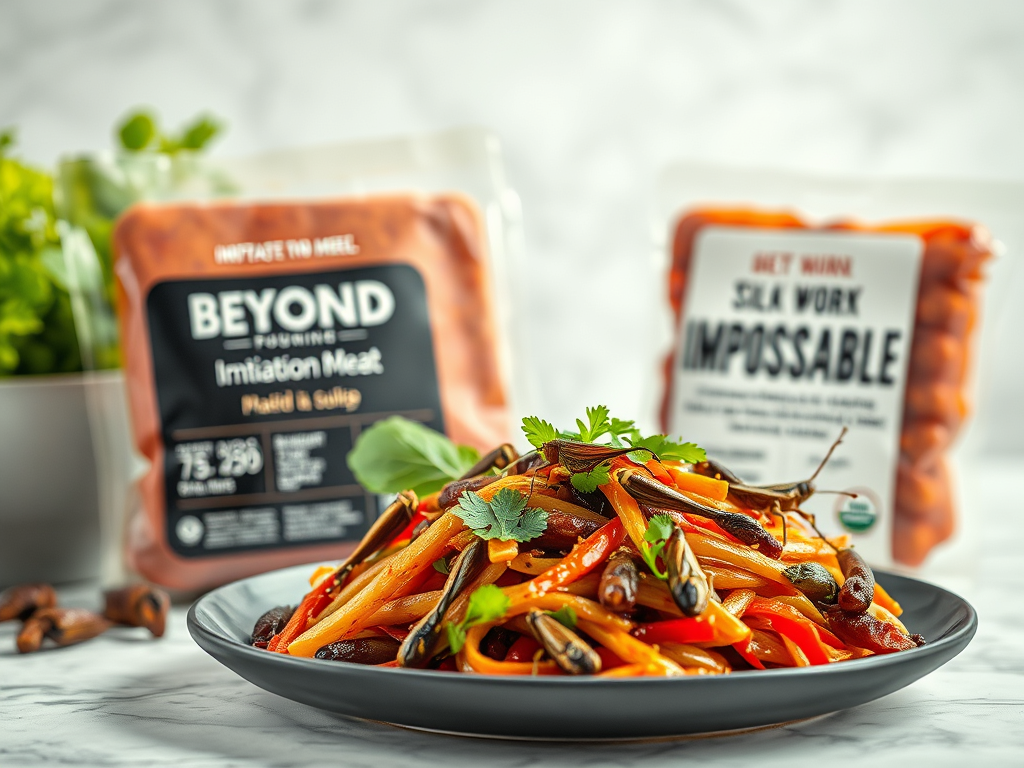
In Seoul, there was a Japanese pub with an intriguing menu item: stir-fried grasshoppers. Seeing it listed repeatedly piqued my curiosity, so I decided to give it a try. A colleague dining with me commented that the taste was surprisingly similar to shrimp. The crispy, soy-sauced grasshoppers didn’t leave much of an impression on me, but they were, interestingly, farm-raised specifically for consumption.
Currently, the FDA does not provide a specific list of approved edible insects. However, the intentional use of insects in food is permitted under U.S. regulations, as long as food safety standards are strictly adhered to. In Japan, there is no formal list of government-approved edible insects, but a 1919 study documented 55 species commonly consumed, including rice grasshoppers, crickets, and wasps. In contrast, (S) Korea’s Ministry of Food and Drug Safety has approved seven insect species as food ingredients: rice grasshoppers, two-spotted crickets, silkworms, silkworm pupae, mealworm larvae, larvae of the white-spotted flower chafer, and larvae of the rhinoceros beetle.
Edible insects are frequently highlighted as future protein sources in the media. While their rapid reproduction and high feed efficiency are beneficial to farmers, it is also noted that cricket farming requires only 25% of the space and feed needed for cattle farming. Additionally, greenhouse gas emissions, including CO2 and methane, could be reduced to 0.25% of current levels, presenting a potential solution to the problems of excessive livestock farming.
Despite their nutritional benefits and relatively pleasant taste, edible insects have yet to become mainstream protein sources. A 2016 survey in South Korea revealed that the primary barrier to their consumption was “disgust,” cited by 61.4% of housewives and 53.1% of college students, followed by a perceived lack of necessity. Personally, I sometimes buy canned silkworm pupae as a beer snack, much to the bewilderment of my wife and daughter, who find it odd that I am eating “bugs.” My lack of aversion to silkworm pupae likely stems from childhood memories of seeing them as common street food in Korea. Interestingly, I have never tried mealworms, as I still perceive them as “bugs,” underscoring how cultural context shapes our food preferences.
The reluctance to replace meat with other protein sources, like edible insects, stems not only from preconceived notions but also from the difficulty of accepting them as food ingredients. Plant-based proteins offer another alternative. For example, half a block of tofu (150g) contains about 20g of protein, equivalent to 100g of beef brisket, 70g of pork loin, or 125g of pork belly. Despite the comparable protein content and lack of aversion to tofu, it is challenging to replace meat because we do not eat meat solely for nutritional reasons. The variety of tastes and textures among different meats makes it difficult to consume just one type of meat, similar to the challenge of eating only low-fat chicken breast for dieting. This is a significant hurdle for plant-based meat substitutes, which currently only replace ground meat products like hamburger patties, sausages, and meatballs, and cannot fully substitute various meat dishes.
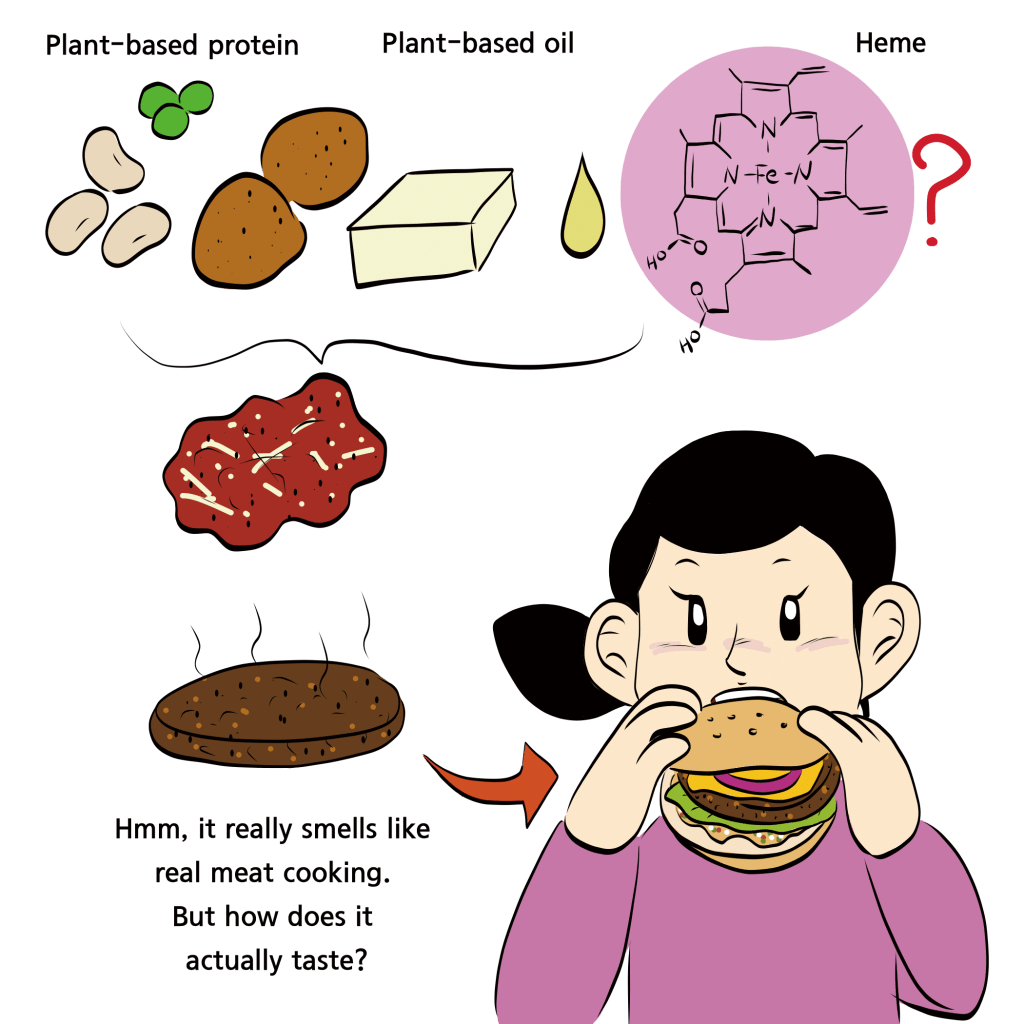
Plant-based meat substitutes have been around for a while. For instance, brown chunks in some instant noodles are soy-based “meat.” I remember eating a burger with a dry, greasy soy-based patty. Recently, plant-based patties from companies like Beyond Meat and Impossible Foods have gained popularity. These companies have developed plant-based patties that mimic the texture and flavor of meat using various additives. Few compounds are responsible for meat’s distinctive flavor, primarily formed during the Maillard reaction and fat degradation, such as furfuryl mercaptan (2-furfurylthiol), 2-methyl-3-furanthiol, and 4-hydroxy-2,5-dimethyl-3-(2H)-furanone.
However, replicating meat flavor with additives alone has proven difficult. In 2019, Impossible Foods introduced the ImpossibleTM Burger 2.0, adding heme from leghemoglobin, an oxygen-transport protein found in soy plants, to their plant-based meat, achieving significant market success.
In addition to protein, meat provides essential minerals and vitamins like iron and vitamin B12. Iron, found mainly in hemoglobin and myoglobin, is vital, requiring 10 – 18 mg daily. While iron is abundant in beans and spinach, its non-heme form is less absorbable by the body. Meat provides heme-bound iron, which is more efficiently absorbed in the small intestine and utilized in the body.
Impossible Foods claims that heme in myoglobin, abundant in red meat, accounts for 95% of meat’s flavor and aroma, suggesting that stable iron intake through meat is another reason we enjoy it. However, the necessity of heme for making plant-based meat taste like real meat remains debated. Beyond Meat, another plant-based meat company, produces heme-free patties using pea protein and beet juice for a meat-like appearance, also achieving positive market responses. When I tried Beyond Meat’s burger, I found no significant difference from regular hamburgers.
Plant-based meats report lower cholesterol and trans fat content, reducing cardiovascular disease risks. These products typically include soy or pea protein, potato protein, gluten, coconut oil, and sunflower oil. Their caloric and saturated fat content is similar to beef patties, though they contain more sodium. Both companies aim to reduce environmental pollution from excessive livestock farming rather than focusing on creating healthier food options.
While not yet commercially available, you may have heard about cultured meat through various media. Cultured meat, produced by culturing animal muscle cells, is a burgeoning field alongside artificial organ and 3D organoid technology, leading to numerous startups. In December 2020, Singapore approved the sale of cultured chicken. However, current technology faces high production costs and environmental challenges similar to livestock farming, posing significant hurdles for cultured meat’s success.
Cultured meat faces challenges in replicating the complex texture of real meat, including muscle fibers, fascia, tendons, and fat distribution. Although current 3D bioprinting technology is capable of creating small artificial tissues or tumor models for research purposes (which happens to be my research group’s focus!), further advancements in this field could pave the way for the efficient production of larger, more realistic muscle tissues, bringing truly lifelike cultured meat closer to reality.
Proteins are essential for a healthy life, and we primarily obtain them from meat. Increasing meat consumption due to population growth has led to excessive livestock farming, causing numerous problems. Awareness of these issues has spurred efforts to find alternative protein sources, showing some promise. However, completely replacing the diverse meat-based culinary culture developed over millions of years remains challenging.
Suddenly replacing all meat consumption with alternative proteins is unrealistic. However, reducing meat intake by incorporating alternative proteins can help mitigate adult disease risks. Introducing alternative proteins into children’s diets can help normalize non-meat protein sources, much like how silkworm pupae have become an accepted snack in many Asian countries.
References
- Kim Su-hee, World Agriculture, 2017, 207, 1
- https://www.insectgourmet.com/a-guide-to-eating-insects-in-tokyo/?utm_source=chatgpt.com#google_vignette
- Ministry of Food and Drug Safety, Open Maru, https://www.mfds.go.kr/webzine/201610/02.jsp
- Kim Su-hee. 2016. Development of Insect Cuisine Recipes for Wanju County: Research Report
- Wu and Cadwallader, J. Agric. Food Chem., 2002, 50, 10, 2900–2907
- Mottram, Food Chem., 1998, 62, 415-424
- https://www.impossiblefoods.com/heme
- Pizzaro et al., The Journal of Nutrition, 2003, 133, 2214–2217
- Dang, Impossible Burger CEO Lectures on Destructive Tech, The Justice, 09/13/16
- https://www.beyondmeat.com/
 Leo & Leah
Leave a comment