
Hugh Kim & Dongjoon Im
Every day, we are bombarded with countless pieces of information, most of which we simply let pass by. The mundane repetition of daily life is often forgotten within a matter of days. However, moments of particular joy or sadness, or new experiences, are stored in our memories. We reflect on these memories, finding comfort or drawing lessons for a better future.
But what if a cherished memory, one you never wanted to forget, disappeared in an instant, beyond your control? Such loss can feel devastating, not just for the person who loses the memory but perhaps even more for the loved ones who shared those memories. If a person also loses their sense of self and the automatic behaviors necessary for daily life, the challenges for their family and friends become even greater.
So, how much do we know about Alzheimer’s disease? The first pathological markers that defined Alzheimer’s disease were senile plaques found in the brain and neurofibrillary tangles (NFTs) in neurons. These are now known to be composed of amyloid-beta (Aβ) and tau proteins, respectively.
The identity of the Aβ peptide was first revealed in 1984 through analysis of amyloid plaques found in the blood vessels of individuals with Down syndrome. This analysis determined the peptide’s sequence. Further research revealed that the sequence of the Aβ peptides forming the senile plaques was identical, except for the absence of two amino acids at the protein’s C-terminus. The discovery of the amyloid precursor protein (APP) gene clarified that Aβ peptides are generated through enzymatic cleavage of APP (see “Diverse Pathways of Amyloid Aggregation and Kinetics (Part 2)” for more details). Eventually, Aβ fibrils were identified as the main component of the senile plaques in the cerebral cortex, forming pathological markers alongside tau protein tangles as the brain ages and in the context of Alzheimer’s disease.
While we seem to know a fair amount about Aβ peptides, our understanding remains limited. The most critical question—how Aβ peptides cause Alzheimer’s disease—remains largely unanswered.
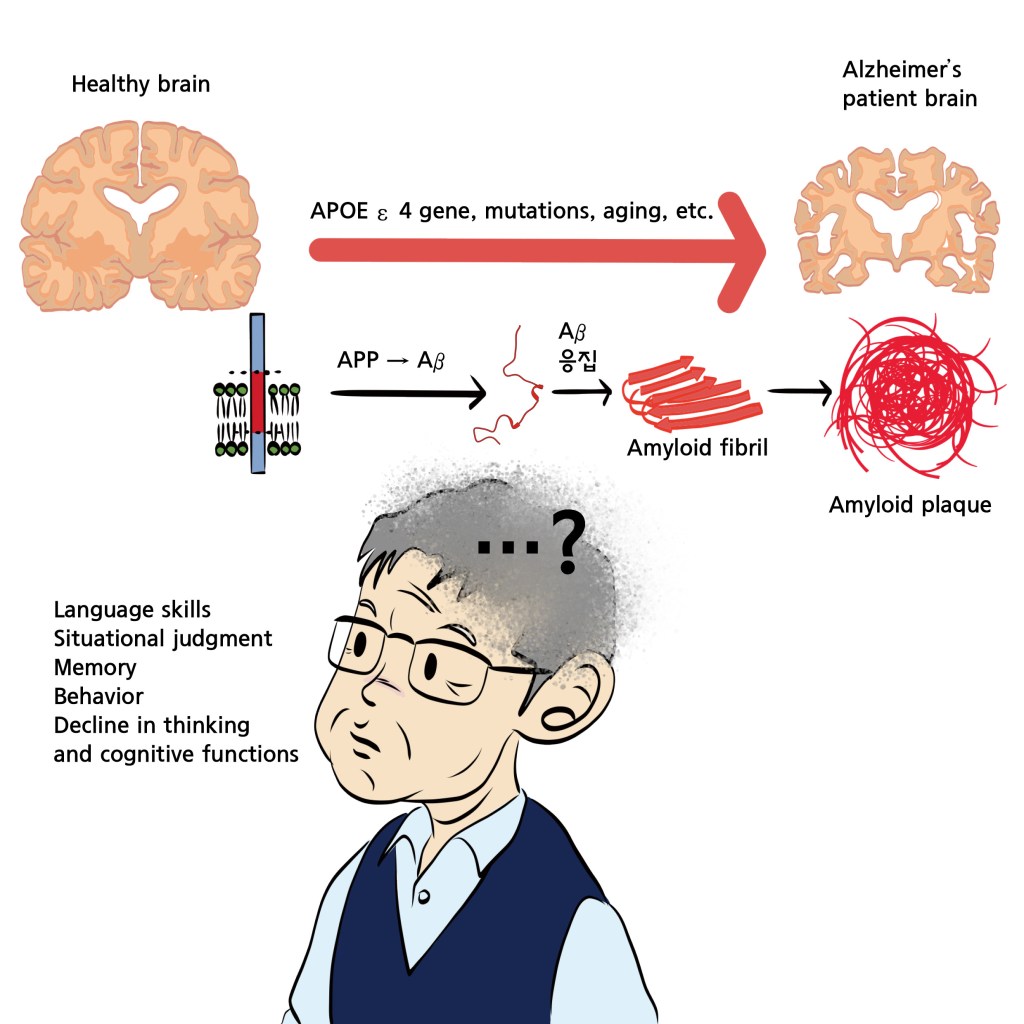
Interestingly, Aβ peptides are present in the brains of everyone, not just those with dementia. So why are they considered key markers in Alzheimer’s research? While the exact causal relationship is unclear, long-standing statistical evidence supports this conclusion. Let’s examine the relationship between Down syndrome and Alzheimer’s disease.
Down syndrome is a genetic disorder caused by an extra copy of chromosome 21. The APP gene, which gives rise to amyloid-beta protein, is also located on chromosome 21. Increased APP expression naturally leads to higher chances of Aβ generation. People with Down syndrome often experience cognitive impairments associated with Alzheimer’s, which is thought to be linked to APP overexpression.
However, chromosome 21 encodes many proteins, not just APP. Thus, the association between Aβ and Alzheimer’s cannot be established solely based on Down syndrome. Comprehensive research has identified at least 25 types of Alzheimer’s associated with mutations in the APP gene. Beyond increased APP expression, point mutations in the APP gene can also elevate Aβ production. These mutations may make APP more susceptible to enzymatic cleavage or lower the energy barrier for Aβ fibril formation.
Can mutations in genes encoding enzymes that act on APP also cause Alzheimer’s? Yes. Alzheimer’s diseases linked to mutations in APP or related enzymes are classified as early-onset Alzheimer’s disease (EOAD). These mutations increase Aβ production, leading to disease onset before the age of 65.
The most well-known genetic risk factor for late-onset Alzheimer’s disease (LOAD) is the APOE ε4 gene, which encodes apolipoprotein E4 (ApoE4). While the most common APOE allele, ε3, is found in 77% of the population, ApoE4 significantly increases the risk of LOAD. Though the precise mechanisms are unclear, it is hypothesized that ApoE4 interferes with the transport of amyloid-beta to lysosomes for degradation, potentially through interactions with LDL receptor-related proteins. Other proteins involved in inflammation, immune response, cellular trafficking, lipid metabolism, and post-translational modifications are also influenced by genes linked to LOAD.
Given the critical role of Aβ in Alzheimer’s disease, significant efforts have focused on targeting this peptide to develop treatments. These efforts led to the FDA approving aducanumab in 2021 under the Accelerated Approval pathway, making it the first Alzheimer’s treatment aimed at modifying the disease rather than solely managing symptoms. Following this, two additional antibody therapies, lecanemab and donanemab, were approved by the FDA in 2023 and 2024, respectively. Both therapies demonstrated effectiveness in reducing amyloid plaques in the brain, which is associated with slowing disease progression.
However, the effectiveness of these antibodies is primarily limited to patients in the early stages of Alzheimer’s disease. This limitation underscores the need for further research to fully understand how Aβ contributes to the disease and to develop more effective strategies for neutralizing its impact.
Please visit the Hugh Kim Research Group homepage.
References
- Glenner, G. G. and Wong, C.W. Biochem Biophys Res Commun 1984, 120(3), 885-890
- Masters, C. L., et al. Proc Natl Acad Sci USA 1985, 82(12), 4245-4249
- Kang, J., et al. Nature 1987, 325(6106), 733-736
- Cras, P., et al. Proc Natl Acad Sci USA 1991, 88(17), 7552-7556
- Hooli, B. V., et al. Neurology 2012, 78(16), 1250-1257
- Hendriks, L., et al. Nat Genet 1992, 1(3), 218-221
- Grabowski, T. J., et al. Ann Neurol 2001, 49(6), 697-705
- Nyarko, J. N., et al. Neuroscience 2018, 373, 20-36; Mahley, R. W., et al. Science 1988, 240(4852), 622-630
- Tachibana, M., et al. J Clin Invest 2019, 129(3), 1272-1277
- Sevigny, J., et al. Nature 2016, 537(7618), 50-56
- https://www.fda.gov/drugs/our-perspective/fdas-decision-approve-new-treatment-alzheimers-disease?utm_source=chatgpt.com
- https://www.fda.gov/news-events/press-announcements/fda-converts-novel-alzheimers-disease-treatment-traditional-approval?utm_source=chatgpt.com
- https://www.alz.org/news/2024/fda-approve-kisunla-donanemab-alzheimers-treatment?utm_source=chatgpt.com
 Leo & Leah
Leave a comment