
Korea’s “Buldak Artificial Spicy Chicken Flavor Ramen” is popular in many countries, including the United States. It appears in numerous movies and TV shows, including Netflix’s “The Sun Brothers.” This extreme spiciness is colloquially referred to as “Korean spiciness.” Korean spiciness is notorious worldwide. While it wasn’t always this intense, at some point, the heat in Korean food escalated to levels I now find hard to handle. Once, I bought chicken skewers from a street vendor in Korea and suffered from the spiciness for nearly an hour. I also shed tears after trying Buldak Ramen when it was first introduced.
Spiciness is not actually a taste. Unlike salty, savory (umami), sweet, bitter, and sour tastes, which are detected by specific receptors on taste buds, spiciness is a sensation similar to pain. It is perceived through receptors found in pain-sensitive nerve endings. Most of us know from school that spiciness is related to pain, but we may not be aware of the differences in how we experience the heat from chili peppers, wasabi, mustard, garlic, and black pepper.
First, let’s discuss the spiciness of chili peppers. Widely known and even sold in purified forms, the spiciness of chili peppers, central to Korean cuisine, is due to a compound called capsaicin. The capsaicin receptor, identified as TRPV1, is a “temperature-sensitive” TRP channel discovered in the 1990s. It triggers pain sensations at temperatures above 43°C to protect us from potential damage. This receptor is present not only in the mouth but also in the skin, inducing pain to prompt us to avoid hot sources.
When the temperature exceeds a certain threshold, TRPV1 receptors activate, allowing sodium (Na+) and calcium (Ca2+) ions into cells, creating a voltage difference. This voltage change sends signals through pain-sensing neurons (nociceptors) to the brain, where we perceive pain. Capsaicin binds to these receptors, mimicking the effect of high temperatures. Thus, eating spicy food causes a burning sensation, reddening of the face, and sweating. Capsaicin essentially tricks the nervous system and brain.
Interestingly, humans are unique in enjoying this pain. Capsaicin’s interaction with TRPV1 receptors also impacts mood regulation and neural cell regeneration. The slight dizziness from eating spicy food is attributed to this effect, contributing to stress relief.
This phenomenon involves the release of neurotransmitters such as endorphins and dopamine. When we experience pain, our body releases endorphins to block pain signals, providing relief, and dopamine as a reward to help us overcome the discomfort. The issue is that frequent and high consumption of capsaicin decreases sensitivity, requiring increasing amounts to achieve the same level of spiciness.
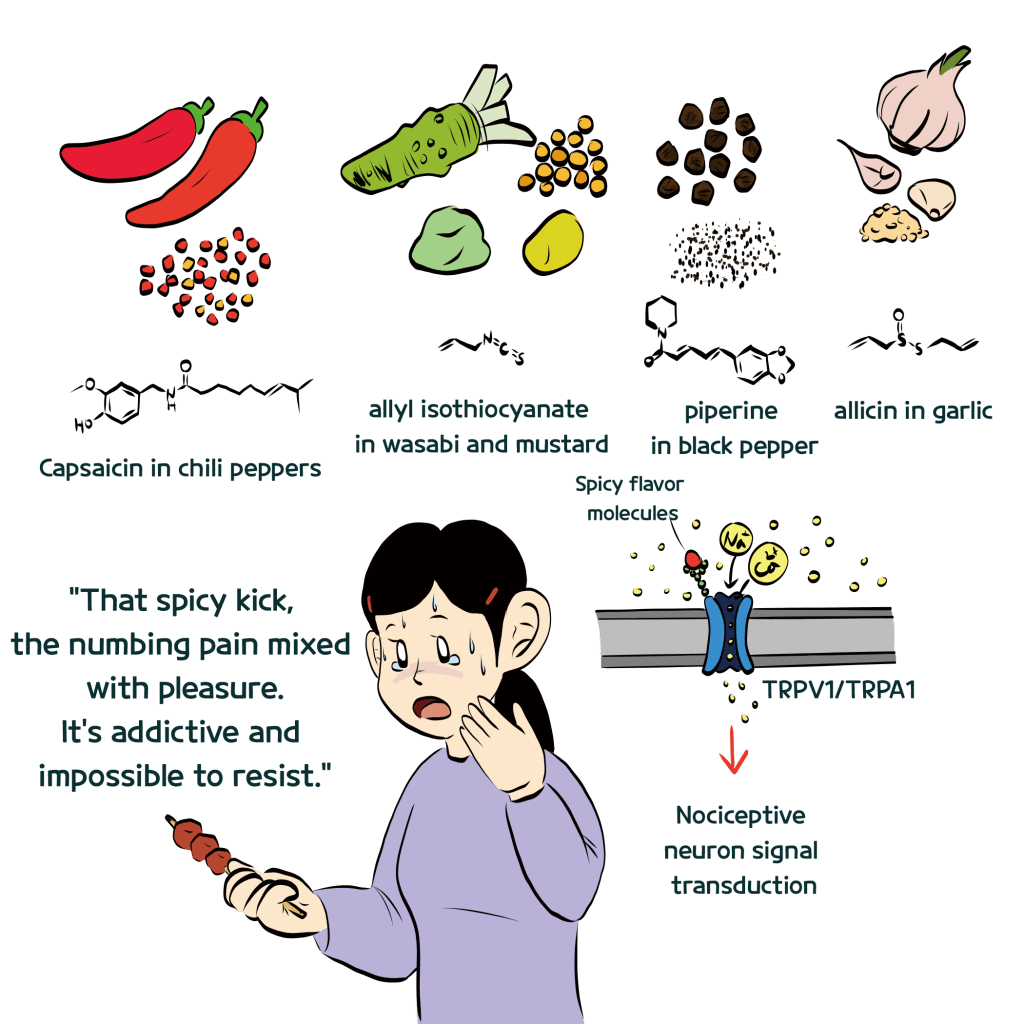
The spiciness of wasabi and mustard comes from a compound called allyl isothiocyanate (AITC). This compound is produced when the cells of wasabi root or mustard seeds are crushed, activating an enzyme reaction. AITC activates not only the TRPV1 receptors but also the TRPA1 receptors, which are sensitive to low temperatures (below 17°C). Although the mechanism differs slightly, the sensation is similar to that of capsaicin.
Horseradish also owes its spiciness to AITC. Wasabi is notoriously difficult to cultivate, making authentic wasabi sauce expensive. As a result, many products labeled as wasabi sauce are actually made from horseradish, mustard, and green food coloring. Genuine wasabi contains higher amounts of AITC, providing a stronger pungent taste.
The spiciness from wasabi, mustard, and horseradish doesn’t linger like that from chili peppers. While drinking water doesn’t alleviate the heat from capsaicin, the sensation from wasabi dissipates quickly. This is because AITC, unlike the non-volatile capsaicin, is highly volatile, allowing it to evaporate from the mouth quickly. This volatility causes the initial sharp sensation but fades soon after. To maintain the distinctive taste of wasabi, it should be stored in airtight containers to prevent AITC from evaporating.
Black pepper is a symbol of the harsh colonial era, representing one of the spices Europeans sought after from the tropics. Columbus’s quest for a black pepper trade route led to the accidental discovery of the Americas and the introduction of chili peppers to Europe.
Black pepper’s spiciness comes from piperine, which, like capsaicin, activates TRPV1 receptors. Although higher quantities of piperine are required for activation, its effect can be as intense as capsaicin. Piperine is also a fat-soluble compound, so consuming fatty foods like dairy can help alleviate the heat.
Garlic, an essential seasoning in many dishes, owes its pungency to compounds like allicin and diallyl disulfide (DADS), both sulfur-containing organic molecules structurally similar to AITC. Allicin activates TRPA1 receptors, producing a similar but distinct heat sensation.
Allicin is noted for its antibacterial and anticancer properties. However, its effects diminish when heated, as both allicin and the enzyme that produces it (alliinase) degrade at high temperatures. This phenomenon also occurs in onions, which contain similar sulfur compounds. Despite these changes, garlic is often used raw in dishes like kimchi and various sauces, preserving its health benefits.
We explored various spicy seasonings and the molecules that cause their heat, highlighting the differences in their effects and how they interact with our senses. Spiciness addiction is likened to the thrill of dangerous activities, involving temperature-sensitive TRP receptors and neurotransmitters like endorphins and dopamine. While spicy food can add excitement to our meals, it’s important to enjoy it in moderation to avoid potential health issues. Seasonings enhance the flavor of our food, but for a healthy diet, we should consume them responsibly.
References
1. Sanz-Salvador et al. J. Biol. Chem. 2012, 287, 19462-19471
2. Yang and Zheng, Protein Cell. 2017, 8, 169–177
3. Iwasaki et al. Biosci. Biotechnol. Biochem. 2008, 72, 2608-2614
4. Arnaud, What’s wasabi, and is your fiery buzz legit?, C&En, 03-22-2010
5. McNarama et al. Br. J. Pharmacol., 2005, 144, 781–790
6. Bautista et al. PNAS, 2005.102, 12248-12252
7. Borlinghaus et al. Molecules. 2014, 19, 12591–12618
8. Song and Milner, J. Nutr. 2001, 131, 1054S–1057S
9. Tirad-Lee, This is your brain on capsaicin, 07-16-2014, Helix
 Leo & Leah
Leave a comment