
Once, I had lunch with some colleagues at a new restaurant. We rushed over right at lunchtime and enjoyed the meal. As we were leaving, one of my colleagues asked, “Didn’t you think the food was heavily seasoned?” I hadn’t noticed, as I’m not particularly sensitive to subtle flavors or aromas. He then mentioned his face felt tight, suggesting it was due to the high amount of monosodium glutamate (MSG) in the food. This reaction is commonly referred to as ‘Chinese Restaurant Syndrome’ or ‘MSG Symptom Complex,’ first reported in 1968 by Dr. Robert Ho Man Kwok in the New England Journal of Medicine (NEJM). He described symptoms like discomfort, sweating, nausea, and muscle cramps following meals containing high levels of MSG.
However, there is a misunderstanding here. Dr. Kwok’s report did not conclusively attribute the syndrome to MSG. He discussed whether the symptoms might be due to the cooking wine used in Chinese food, the MSG, or simply the high sodium content, concluding that more research was needed. Despite this, subsequent reports continued to blame MSG, leading to its infamous reputation. In 1993, Merriam-Webster added “Chinese Restaurant Syndrome” to its dictionary, citing MSG as the cause. This contributed to MSG’s negative image as an unhealthy additive for a generation.
Over the past 50 years, numerous studies have been conducted on MSG. Some reported that MSG could indeed cause symptoms in sensitive individuals when consumed in certain amounts (e.g., 2.5 mg). This led to suggestions to rename the syndrome from “Chinese Restaurant Syndrome” to “MSG Syndrome Complex” to avoid racial bias. Recently, Merriam-Webster has included a note in their dictionary entry for “Chinese Restaurant Syndrome” to also refer to it as “MSG Syndrome Complex.”
The U.S. Food and Drug Administration (FDA) classifies MSG as “generally recognized as safe” (GRAS). However, due to public concern, the FDA requires MSG to be listed on food labels. It’s worth noting that MSG naturally occurs in foods. For example, “dashi,” a Japanese soup stock made from kelp and dried fish, contains natural MSG. When MSG is not artificially added but naturally present, it does not need to be listed as an ingredient.
MSG was first isolated by Japanese chemist Kikunae Ikeda and his team in 1908 from kelp, identifying it as the compound responsible for umami, or savory taste. A year later, in 1909, the Japanese food company Ajinomoto began selling MSG as a seasoning. Umami was officially recognized as the fifth basic taste, alongside sweet, bitter, salty, and sour, with its international name derived from Japanese.
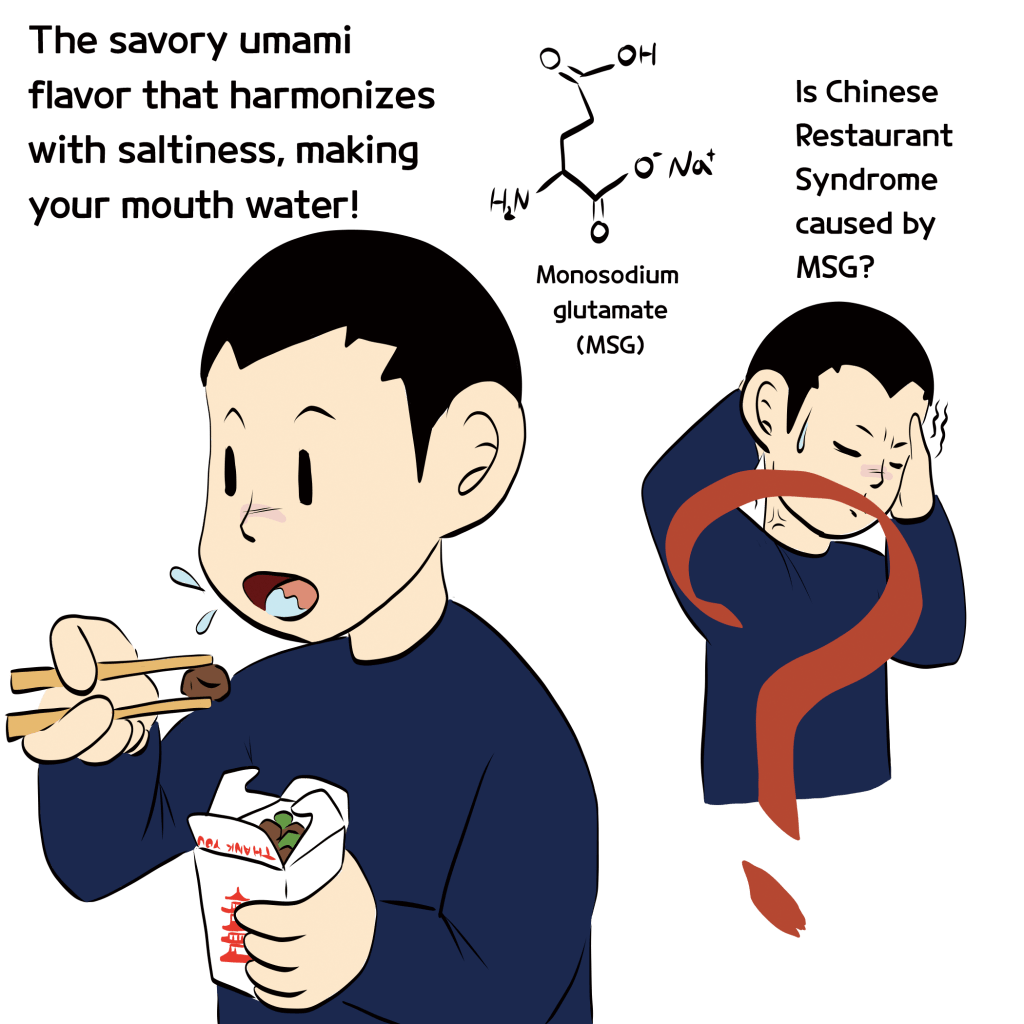
MSG is the sodium salt of glutamic acid, an essential amino acid. In its free form, glutamic acid loses a proton from its carboxylic acid group, forming a negatively charged ion that bonds with sodium to create MSG. This ionic compound is highly polar, readily dissociating in water into sodium and glutamate ions, each interacting with their respective taste receptors.
Glutamate ions bind to umami receptors (taste-mGluR1/4, T1R1/T1R3) on taste cells, eliciting the savory taste. Glutamate is naturally present in many foods, including milk. The first encounter with umami is typically through breast milk. This taste mechanism likely evolved to promote the consumption of essential proteins, aiding in digestion and nutrient absorption. When umami is detected, it stimulates saliva and digestive fluid secretion, enhancing protein breakdown in the digestive system. Interestingly, foods high in glutamate, such as corn, tomatoes, and persimmons, do not always contain high protein levels. This suggests that the umami taste may have evolved to indicate the presence of protein-rich food sources rather than protein itself.
In summary, MSG is a naturally occurring compound that has always been part of our diet, contributing to the umami taste. Its discovery in the 20th century merely identified what was already present in many foods. Despite extensive research, no conclusive evidence has linked MSG to “Chinese Restaurant Syndrome.” The Korean Food and Drug Administration (KFDA) has declared MSG safe for lifelong consumption and has banned labels like “No MSG” or “MSG Free” to prevent consumer misconceptions. Similarly, the U.S. FDA recognizes MSG as safe for consumption, though foods with added MSG must list it on their ingredient labels.
The lethal dose (LD50) of MSG is 16,000 mg/kg, classifying it as a non-toxic substance. However, as with various allergic reactions that vary among individuals, some people may temporarily react to MSG. Those sensitive to MSG should avoid foods containing it.
While MSG has endured a controversial history, current scientific evidence supports its safety for the general population. It is naturally found in many foods and contributes to the umami taste. Understanding MSG’s role and its safety can help dispel myths and allow for informed dietary choices.
References
- Kwok, N Engl J Med 1968, 278, 796
- https://www.merriam-webster.com/
- Yang et al. J. Allergy Clin. Immunol., 1997, 99, 757
- Hartely et al. Nutrient, 2019, 11, 182
- The revision of the KFDA (Korean Food and Drug Administration) regulations regarding MSG (May 18, 2010)
- Code of Federal Regulations (CFR), Title 21, Section 101.22(h)
 Leo & Leah
Leave a comment