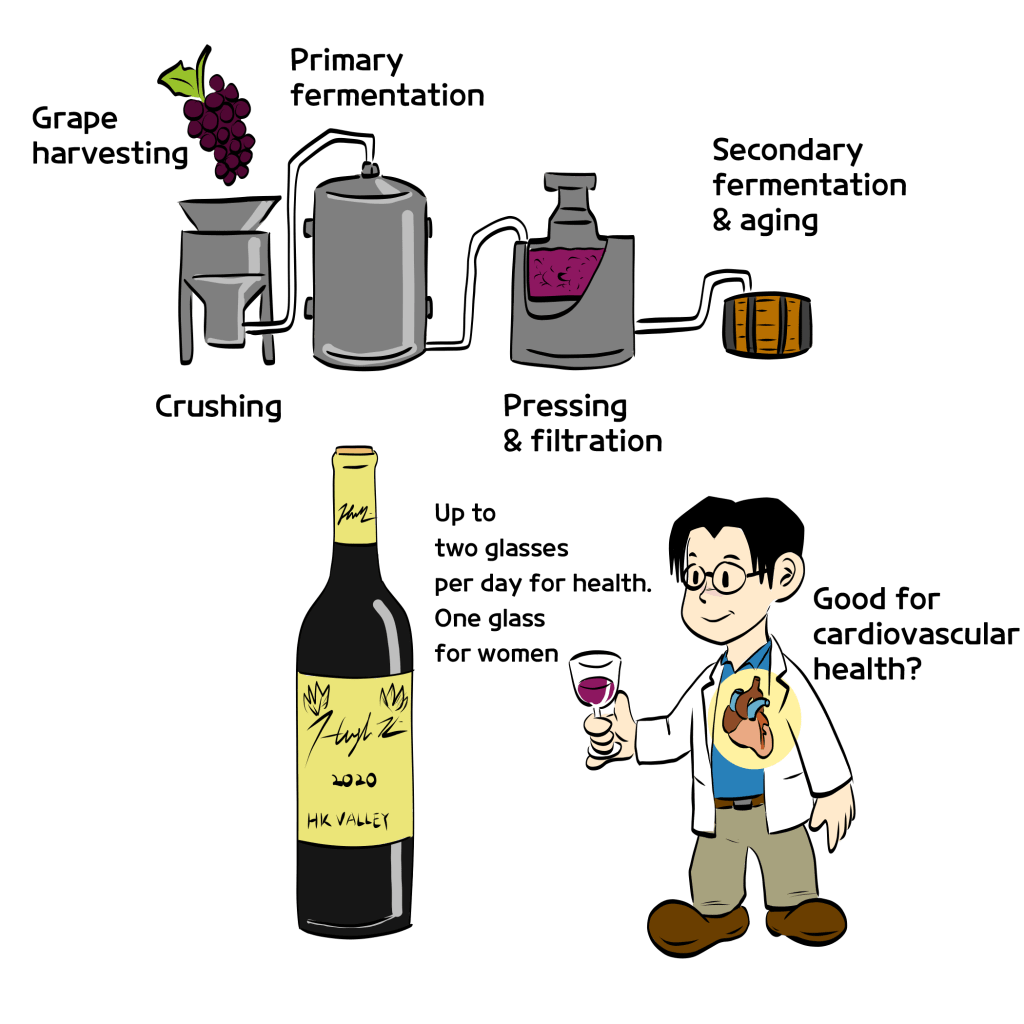
The winemaking process, at its core, isn’t vastly different from brewing beer. It begins with the harvesting of well-ripened grapes. Since the sugars in grapes are the main ingredient for fermentation, the quality of the grapes significantly determines the quality of the wine. This is why the outcome of the grape harvest each year is so crucial to winemaking.
After harvesting, the grapes are de-stemmed and crushed to produce grape juice called must. For red wines, black grapes are crushed with their skins and seeds. For white wines, only the juice from black or green grapes is used. The extent of pressing determines the amount of tannins and other compounds extracted from the skins and seeds. While tannins cause astringency, they also act as antioxidants that prevent wine from oxidizing during long aging processes, thus their amount must be carefully controlled from the beginning. Grapes intended for long-aged red wines typically have higher tannin levels. Grape varieties with lower tannin levels, like Pinot Noir, can be more challenging to produce and often command higher prices.
The grape juice undergoes primary fermentation in tanks where yeast ferments the sugars. The wine is then pressed and filtered before aging in oak barrels for 1-2 years. Some wines undergo malolactic fermentation, which converts malic acid into lactic acid, either during or after primary fermentation. Unlike primary fermentation, which uses yeast, malolactic fermentation uses lactic acid bacteria to convert the sharper malic acid into the softer lactic acid, giving the wine a smoother, creamier taste reminiscent of fermented dairy products. During this process, tannins also react with anthocyanin pigments, reducing astringency and softening the color of the wine. Carbon dioxide from the fermentation evaporates, and tannins that have polymerized with yeast precipitate out, which can be filtered after aging. The most important purpose of aging is to infuse the wine with aromatic compounds from the oak barrels. Nowadays, instead of using expensive handcrafted oak barrels, oak chips or staves are often added to the aging tanks, or oak extracts are directly infused into the wine.
A long aging period is necessary because it takes time for the aromatic organic molecules from the oak to dissolve into the wine, which is an aqueous solution consisting of 85% water and 12% ethanol. Sparkling wines are produced by adding sugar to finished white wine and allowing the residual yeast to ferment further, creating carbonation.
Wine experts and enthusiasts can detect the subtle combinations of molecules that form the flavors and aromas of wine with high sensitivity and precision, a skill perfected by sommeliers (leaders of pristine wine service and cultivators of an elevated dining experience). However, even those who are not wine aficionados can discern certain differences in wine. One of the easiest distinctions to make is based on the grape variety. The taste of wine varies significantly depending on the grape variety used, and some of the most common varieties used in popular wines include:
Cabernet Sauvignon: Originating from Bordeaux, France, but now grown in California, Italy, Spain, Chile, Australia, and other regions. It is high in tannins, making it astringent but suitable for long aging, resulting in wines with rich flavors and varying price points. Its high acidity makes it a common choice for blending with Merlot or Cabernet Franc.
Merlot: Also from Bordeaux, France, but widely cultivated elsewhere. Merlot has lower acidity and tannins than Cabernet Sauvignon, making it sweeter and juicier, often used in blends to soften stronger wines.
Pinot Noir: Grown in cooler climates, most notably in the Côte-d’Or region of Burgundy, France. Difficult to cultivate, Pinot Noir wines are expensive and highly regarded, often referred to as “snobby wines.” Served slightly chilled (12°C), they are known for their fruity and refreshing flavors. White wines made from Pinot Noir are used in sparkling wine production.
Syrah/Shiraz: Dark-skinned grapes from southeastern France, hardy and widely grown. Syrah wines are known for their deep, robust flavors, high tannin content, and aromatic richness. They are often blended with Cabernet Sauvignon, Merlot, and other varieties.
Nebbiolo: A prominent Italian variety from the Piedmont region, high in tannins and acidity, used for long-aging wines.
Tempranillo: A key Spanish variety, also high in tannins and acidity.
White wine grapes also contain tannins, but the amount in the wine is much lower since the skins and seeds are not included in the fermentation. White wines are generally sweeter and more fragrant, with common varieties including Chardonnay, Riesling, and Sauvignon Blanc. Numerous other grape varieties and blends create a wide range of wine flavors.
One reason wine has gained popularity in the world is its reputation as a “healthy drink.” Wine does contain water (85%) and various beneficial compounds like polyphenols, tannins, and organic acids. However, the problem lies in the 10 – 15% ethanol content. Similar to how juices are healthy but problematic due to high sugar content, wine is considered healthy but has the issue of ethanol produced by fermentation. Various media sources recommend that adult men drink no more than two glasses (~ 10 oz) of wine per day and women no more than one glass (~ 50 oz). Excessive consumption can cause liver damage, and even when taking pain relievers like Tylenol, it is advised to consult a doctor if you consume more than three glasses of wine per day. The basis for the “two glasses of wine per day” recommendation is unclear, and it’s not definitive that wine is healthier than other alcoholic beverages. Regular heavy drinking is more likely to have disadvantages than advantages. The beneficial compounds found in wine are also abundant in the fruits and vegetables we consume daily.
In conclusion, while wine offers a rich and complex experience due to its vast variety and nuanced flavors, it should be enjoyed responsibly, considering both its potential health benefits and risks.
References
- Mysels, J. Opioid Manag. 2010 6, 445
- https://www.chemsafetypro.com/Topics/CRA/acute_toxicity_ld50_lc50.html
- https://www.therecoveryvillage.com/alcohol-abuse/
- Chiara, Alcohol Health Res. World. 1997, 21, 108
- Cervera-Juanes et al. Mol Psychiatry. 2016, 21, 472
- https://www.drugabuse.gov/drug-topics/alcohol
- Palmer, (2017) How To Brew: Everything You Need to Know to Brew Great Beer Every Time, 4th Ed., Brewers Publications
- Hornsey, (2003) A History of Beer and Brewing, Royal Society of Chemistry
- Olaniran et al. J. Inst. Brew. 2017, 123, 13
- Devitt, 500 years ago, yeast’s epic journey gave rise to lager beer, https://news.wisc.edu/. 2011. 08. 22.
- Stack, A Concise History of America’s Brewing Industry, EH.net
- Gajanan, How to Talk About Beer Like a Pro, Time, 2018. 04. 07
- https://beerandbrewing.com/dictionary/tUHp3R5egg/
- Ting & Ryder, J. Am. Soc. Brew, Chem., 2017, 75, 161
- BYO Staff, Using Roasted Barley: Tips from the Pros, byo.com, 2004. 01
- https://www.simpsonsmalt.co.uk/blog/malt-production-process-roasting/
- Carlin and Rosentha, (1998) Food and eating in medieval Europe, Hambledon Press
- Mitchell and Herlong, Annu. Rev. Nutr., 1986, 6, 457
- Zelman, The Truth About Beer, webMD, 2014. 08.
- Hobson and Maughan, Alcohol Alcohol., 2010, 45, 366
- Cuzzo and Lappin, Vasopressin (Antidiuretic Hormone, ADH), StatPearls [Internet], 2019
- Chiba and Phillips, Addict. Biol, 2000, 5, 117
- Fugelsang and Edwards, (2010) Wine Microbiology, 2nd Ed., Springer Science and Business Media
- Adams, The Science of Winemaking Yeasts, Sevenfiftydaily, 2018. 06. 06.
- Remize et al. Yeast, 2003, 20, 1243
- Russan, The Science of Tannins in Wind, SevenFiftyDaily, 2019. 02. 07.
- Rovner, C&En, 2006, 84, 30
- Robles et al. TrAC-Trends Analyt. Chem., 2019, 120, 115630
- Hines, These Are the Chemical Compounds That Make Wine Taste So Good, Vinepair, 2017. 09. 24.
- Corliss, Is red wine actually good for your heart?, Harvard Healthy Blog, 2018. 02. 19.
- Panesar (2014) Biotechnology in Agriculture and Food Processing: Opportunities and Challenges, CRC Press
- Bang et al. Korean J. Food Cook Sci., 2016, 32, 44
- Takahashi & Kohno, PLos One, 2016, 11, e0150524
- https://en.sake-times.com/learn/the-science-of-sake-aroma
- https://thesool.com
- Casey & Ingledew, Crit. Rev. Microbiol., 1986, 13, 219
- Jin et al. Trends Food Sci. Technol. 2017, 53, 18
- Karlsson & Friedman, Sci. Rep., 2017, 7, 6489
- Tsakiris et al. J Sci Food Agric 2014; 94: 404
- http://www.snuh.org/health/compreDis/OT01/6.do
 Leo & Leah
Leave a comment