
There’s a common saying among heavy drinkers that “you can keep drinking beer until you’re too full.” I recently read an article about a bar that offers a prize for drinking 100 fl oz of beer in one shot. How is it possible to drink so much beer? The reason is that ethanol increases urine production, leading to dehydration. Consuming 10 g of ethanol (about 0.34 fl oz) can cause an additional 3.4 fl oz of urine output. Part of the increased urination during drinking is due to ethanol inhibiting the secretion of vasopressin, an antidiuretic hormone. This means that drinking a can of beer can cause you to produce an extra 8 oz of urine, making you thirstier and encouraging more drinking. Additionally, the carbonation, sugars, and electrolytes in beer make it easy to drink in large quantities.
The day after heavy drinking, you may find yourself frequently running to the bathroom with diarrhea. This happens because ethanol overly stimulates bowel movements, preventing the colon from absorbing water properly, and leading to loosened stools. Combined with the increased urination from the previous night, excessive diarrhea can worsen dehydration symptoms. It’s wise to keep your alcohol consumption in check and drink plenty of water before and after drinking.
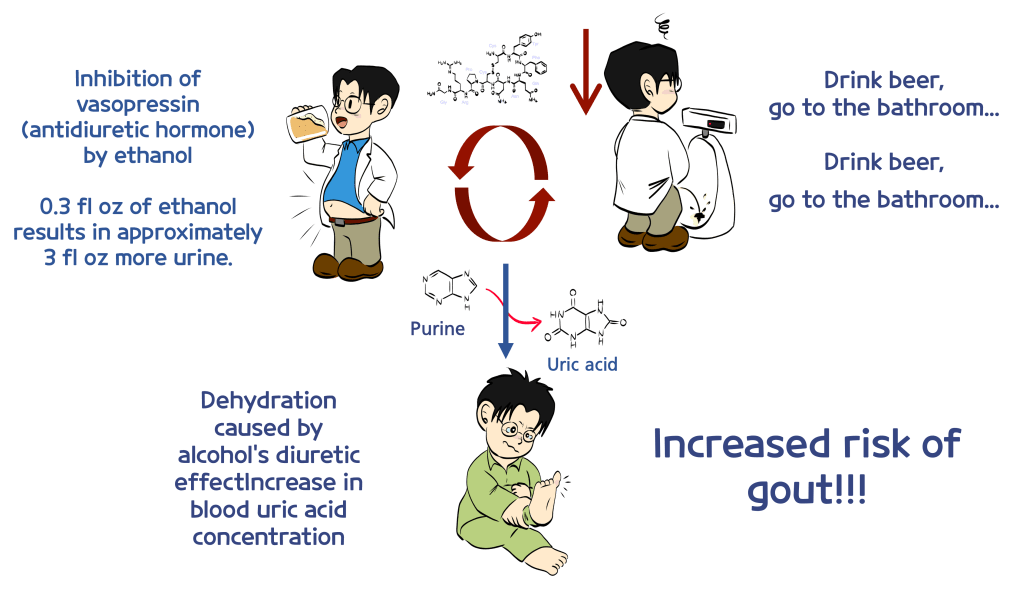
We have discussed the addictive properties and dehydrating effects of ethanol. There’s another serious health concern associated with beer consumption—gout. Gout is a condition characterized by intense pain, often described as a feeling of extreme sensitivity to even the lightest touch, caused by elevated uric acid levels in the blood, known as hyperuricemia. Uric acid is a byproduct of the metabolism of purines, which are found in high amounts in meat and fish, and it is usually excreted in urine. When uric acid levels in the blood become too high, it can form crystals in the joints or blood vessels. The immune system treats these uric acid crystals as foreign invaders, triggering an inflammatory response that causes the severe pain of gout.
Beer contains the highest purine content among alcoholic beverages and promotes uric acid synthesis, increasing blood uric acid levels. The dehydration caused by beer further elevates uric acid concentration in the blood. However, it’s not just beer that raises uric acid levels; frequent alcohol consumption and high-calorie food intake can also lead to hyperuricemia and gout. Even excessive consumption of sugary drinks like soda and juice can increase the risk of gout. Meat-based snacks commonly enjoyed with beer also contribute to higher uric acid levels. Gout is a chronic metabolic disease that requires consistent medication and lifestyle changes to manage blood uric acid levels effectively.
There are claims that consuming beer yeast is beneficial for health. Beer yeast, a single-celled fungus, contains chromium and B vitamins. Some reports suggest that beer yeast may help prevent hair loss. However, the amount of these nutrients present in beer is too small to have a significant effect. The fact remains that people drink beer because it tastes good, not for health benefits. Moderate drinking can bring enjoyment and richness to our lives, but excessive drinking can lead to many adverse effects.
In conclusion, while beer is an enjoyable beverage with a rich history and a diverse array of flavors, it is important to consume it responsibly and be aware of its potential health impacts.
References
- Mysels, J. Opioid Manag. 2010 6, 445
- https://www.chemsafetypro.com/Topics/CRA/acute_toxicity_ld50_lc50.html
- https://www.therecoveryvillage.com/alcohol-abuse/
- Chiara, Alcohol Health Res. World. 1997, 21, 108
- Cervera-Juanes et al. Mol Psychiatry. 2016, 21, 472
- https://www.drugabuse.gov/drug-topics/alcohol
- Palmer, (2017) How To Brew: Everything You Need to Know to Brew Great Beer Every Time, 4th Ed., Brewers Publications
- Hornsey, (2003) A History of Beer and Brewing, Royal Society of Chemistry
- Olaniran et al. J. Inst. Brew. 2017, 123, 13
- Devitt, 500 years ago, yeast’s epic journey gave rise to lager beer, https://news.wisc.edu/. 2011. 08. 22.
- Stack, A Concise History of America’s Brewing Industry, EH.net
- Gajanan, How to Talk About Beer Like a Pro, Time, 2018. 04. 07
- https://beerandbrewing.com/dictionary/tUHp3R5egg/
- Ting & Ryder, J. Am. Soc. Brew, Chem., 2017, 75, 161
- BYO Staff, Using Roasted Barley: Tips from the Pros, byo.com, 2004. 01
- https://www.simpsonsmalt.co.uk/blog/malt-production-process-roasting/
- Carlin and Rosentha, (1998) Food and eating in medieval Europe, Hambledon Press
- Mitchell and Herlong, Annu. Rev. Nutr., 1986, 6, 457
- Zelman, The Truth About Beer, webMD, 2014. 08.
- Hobson and Maughan, Alcohol Alcohol., 2010, 45, 366
- Cuzzo and Lappin, Vasopressin (Antidiuretic Hormone, ADH), StatPearls [Internet], 2019
- Chiba and Phillips, Addict. Biol, 2000, 5, 117
- Fugelsang and Edwards, (2010) Wine Microbiology, 2nd Ed., Springer Science and Business Media
- Adams, The Science of Winemaking Yeasts, Sevenfiftydaily, 2018. 06. 06.
- Remize et al. Yeast, 2003, 20, 1243
- Russan, The Science of Tannins in Wind, SevenFiftyDaily, 2019. 02. 07.
- Rovner, C&En, 2006, 84, 30
- Robles et al. TrAC-Trends Analyt. Chem., 2019, 120, 115630
- Hines, These Are the Chemical Compounds That Make Wine Taste So Good, Vinepair, 2017. 09. 24.
- Corliss, Is red wine actually good for your heart?, Harvard Healthy Blog, 2018. 02. 19.
- Panesar (2014) Biotechnology in Agriculture and Food Processing: Opportunities and Challenges, CRC Press
- Bang et al. Korean J. Food Cook Sci., 2016, 32, 44
- Takahashi & Kohno, PLos One, 2016, 11, e0150524
- https://en.sake-times.com/learn/the-science-of-sake-aroma
- https://thesool.com
- Casey & Ingledew, Crit. Rev. Microbiol., 1986, 13, 219
- Jin et al. Trends Food Sci. Technol. 2017, 53, 18
- Karlsson & Friedman, Sci. Rep., 2017, 7, 6489
- Tsakiris et al. J Sci Food Agric 2014; 94: 404
- http://www.snuh.org/health/compreDis/OT01/6.do
 Leo & Leah
Leave a comment