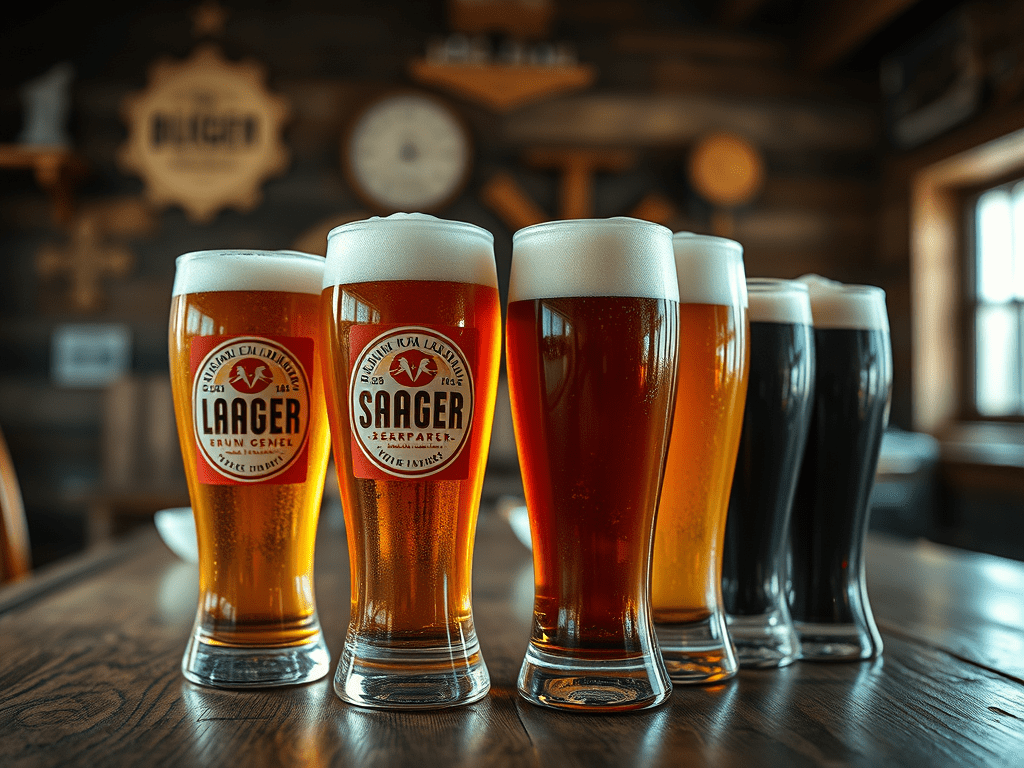
The labels on beer cans typically list the main ingredients as purified water, barley malt, wheat malt, hops, and yeast. However, the variety of beers can be vastly different depending on the origin and treatment of each ingredient. From classic lagers to refreshing ales, and bitter IPAs, even beers brewed by the same company can come in a wide range of types.
Lagers, which dominate the global beer market and thus might not seem novel to us, are actually relatively new in the long history of beer. Lagers were first brewed in the 15th century at the Weihenstephan Monastery Brewery in Bavaria, Germany, which is known as the world’s oldest brewery. Lager yeast ferments at lower temperatures and more slowly than ale yeast. Most of the major beer brands we know today are lager breweries. The development of refrigerators in the 19th century allowed for the stable and continuous fermentation of lagers, leading to their mass production. In contrast, ales are often produced by small breweries using traditional methods, marketed as craft beer. As a result, lagers, produced on a large scale, are more widely distributed and often cheaper than ales. This large-scale production and lower price point are why lagers have become the most common type of beer. Furthermore, lagers are more stable and have a longer shelf life, which makes them ideal for mass distribution. This is one of the reasons why lagers dominate the global beer market.
Lager beers, unlike ales, have less of the distinctive aroma of fermented beverages and a lower alcohol content that doesn’t overwhelm the taste, making them an accessible entry point for many people. Most domestic beers and classic American lagers are prime examples. Personally, my favorite craft lager from the Boston area in the U.S. is also quite renowned. Pilsner, a beer that significantly contributed to the popularization of lagers, was first brewed in Pilsen, Czech Republic. With a strong emphasis on hop aroma, Pilsners have a distinctive bitterness that can be more challenging for newcomers compared to regular lagers. They are among the most famous European lagers.

Pale ale is a common type of ale that features the distinct bitterness of hops and the refreshing flavor typical of ales, making it a bit challenging initially but not overly so. Pale ale is brewed using pale malt, which is roasted at relatively low temperatures, resulting in a lighter color.
India Pale Ale (IPA), derived from pale ale, has a higher alcohol content. First produced in the 1840s in Britain, IPAs were developed to withstand long voyages by the British East India Company without spoiling. Any remaining sugars in the wort could ferment and turn into acetic acid, the main component of vinegar, resulting in sour, spoiled beer. To prevent this, brewers increased the alcohol content (to about 7%) and added more hops, which have antibacterial properties. This combination of ale’s fruity flavor, the bitterness from the high hop content, and the distinct taste of ethanol created a unique beer. Over time, the balance of these components has been adjusted, resulting in various IPAs with different flavors and aromas. British IPAs are known for their strong bitterness, while American IPAs from California are known for their refreshing aroma. As a college student unfamiliar with beer, I once splurged on an expensive IPA, only to regret it because it tasted like bitter herbal medicine to me. For beginners, the high bitterness of IPAs can be a significant barrier.
Stout, a type of ale, is famous for its dark color and rich flavor, with Irish stouts being particularly renowned. Stouts, derived from porters which have a milder coffee aroma, are characterized by their sweet, bitter, and complex flavors, which come from roasting barley at high temperatures (~446°F). This roasting process breaks down the carbohydrates into sugars, which caramelize and give the beer its dark color and rich flavor. The caramelization also produces diacetyl, and the aromatic compounds in barley give stouts their characteristic aroma. Black malt or chocolate malt, roasted at high temperatures, are also used in small quantities to enhance the flavor. When brewing dry Irish stouts, these dark malts are mixed with pale malts and roasted barley. If you enjoy espresso or Americano, you might find stouts more accessible. Dunkel, a dark lager brewed with lager yeast, also has a dark color from the dark malts used.
Belgium has pioneered a unique style of beer, much like their famous chocolates, known as Belgian-style beer. These ales, including pale ales, dark ales, and sour ales, are characterized by their sour and fruity flavors with a sweet taste and minimal bitterness. Trappist monasteries traditionally brew strong and complex Belgian craft beers, such as the high-alcohol and aromatic Belgian Dubbel and Tripel.
As complex as Belgian beers are German wheat beers, known as Weizen. Brewed with a mixture of barley and wheat malts, Weizen beers that are unfiltered and contain yeast are called Hefeweizen. Hefeweizens have low hop bitterness, high carbonation, and rich sweetness and fruity aromas. If you prefer refreshing and tangy flavors, you might find Hefeweizens quite accessible, but they might not appeal as much if you prefer the bitterness typical of hop-forward beers.
References
- Mysels, J. Opioid Manag. 2010 6, 445
- https://www.chemsafetypro.com/Topics/CRA/acute_toxicity_ld50_lc50.html
- https://www.therecoveryvillage.com/alcohol-abuse/
- Chiara, Alcohol Health Res. World. 1997, 21, 108
- Cervera-Juanes et al. Mol Psychiatry. 2016, 21, 472
- https://www.drugabuse.gov/drug-topics/alcohol
- Palmer, (2017) How To Brew: Everything You Need to Know to Brew Great Beer Every Time, 4th Ed., Brewers Publications
- Hornsey, (2003) A History of Beer and Brewing, Royal Society of Chemistry
- Olaniran et al. J. Inst. Brew. 2017, 123, 13
- Devitt, 500 years ago, yeast’s epic journey gave rise to lager beer, https://news.wisc.edu/. 2011. 08. 22.
- Stack, A Concise History of America’s Brewing Industry, EH.net
- Gajanan, How to Talk About Beer Like a Pro, Time, 2018. 04. 07
- https://beerandbrewing.com/dictionary/tUHp3R5egg/
- Ting & Ryder, J. Am. Soc. Brew, Chem., 2017, 75, 161
- BYO Staff, Using Roasted Barley: Tips from the Pros, byo.com, 2004. 01
- https://www.simpsonsmalt.co.uk/blog/malt-production-process-roasting/
- Carlin and Rosentha, (1998) Food and eating in medieval Europe, Hambledon Press
- Mitchell and Herlong, Annu. Rev. Nutr., 1986, 6, 457
- Zelman, The Truth About Beer, webMD, 2014. 08.
- Hobson and Maughan, Alcohol Alcohol., 2010, 45, 366
- Cuzzo and Lappin, Vasopressin (Antidiuretic Hormone, ADH), StatPearls [Internet], 2019
- Chiba and Phillips, Addict. Biol, 2000, 5, 117
- Fugelsang and Edwards, (2010) Wine Microbiology, 2nd Ed., Springer Science and Business Media
- Adams, The Science of Winemaking Yeasts, Sevenfiftydaily, 2018. 06. 06.
- Remize et al. Yeast, 2003, 20, 1243
- Russan, The Science of Tannins in Wind, SevenFiftyDaily, 2019. 02. 07.
- Rovner, C&En, 2006, 84, 30
- Robles et al. TrAC-Trends Analyt. Chem., 2019, 120, 115630
- Hines, These Are the Chemical Compounds That Make Wine Taste So Good, Vinepair, 2017. 09. 24.
- Corliss, Is red wine actually good for your heart?, Harvard Healthy Blog, 2018. 02. 19.
- Panesar (2014) Biotechnology in Agriculture and Food Processing: Opportunities and Challenges, CRC Press
- Bang et al. Korean J. Food Cook Sci., 2016, 32, 44
- Takahashi & Kohno, PLos One, 2016, 11, e0150524
- https://en.sake-times.com/learn/the-science-of-sake-aroma
- https://thesool.com
- Casey & Ingledew, Crit. Rev. Microbiol., 1986, 13, 219
- Jin et al. Trends Food Sci. Technol. 2017, 53, 18
- Karlsson & Friedman, Sci. Rep., 2017, 7, 6489
- Tsakiris et al. J Sci Food Agric 2014; 94: 404
- http://www.snuh.org/health/compreDis/OT01/6.do
 Leo & Leah
Leave a comment