The first alcoholic drink I tried in college was beer. I was blown away by how good it tasted with deep-fried chicken at a little chicken joint in an apartment complex. Then, I was surprised by how cheap canned beer was at the grocery store (only to be shocked later by the high prices at beer pubs) and amazed at the huge variety of beers out there. During my graduate school days, when I was often short on money, I remember spending over an hour in the grocery store, picking up and putting down various bottles of beer and deliberating which new beer to try within my limited budget to celebrate my hard-earned research being published in a journal. Even now, with a beer budget that’s more than ten times what it used to be, I still find myself in a large beverage store packed with a variety of imported beers, pondering which one to enjoy. The world is vast, and there are many beers to try.
Beer is the third most consumed beverage in the world, after water and tea. Its history is so ancient that recipes for beer were found in papyrus records from ancient Egypt (around 5,000 BC). Beer is a fermented beverage. Fermented beverages are those that contain ethanol produced during the metabolic process of microorganisms (such as yeast) breaking down sugars without oxygen to obtain energy. In addition to beer, other representative fermented beverages include wine, makgeolli (Korean rice wine), and sake (Japanese rice wine). Because yeast breaks down sugars to obtain energy, grains or fruits containing carbohydrates are used as the main raw materials. Wine is made from grapes, makgeolli and sake from rice, and beer from barley or wheat malt.
Malt is barley or wheat soaked in water to sprout and then dried. Malt is rich in enzymes like α-amylase and β-amylase, which convert the starches in grains into shorter sugars like glucose, maltose, maltotriose, and maltodextrin. To ensure the sugars in malt ferment well by yeast and enhance the flavor of the beer, the malt is roasted and crushed. The crushed malt is then mixed with water and other grains in a mashing process to create a porridge-like mixture. Heating the mixture to a specific temperature (140 – 158°F) activates the malt enzymes, which efficiently break down the carbohydrates in the grains into a sugar-rich solution suitable for fermentation, known as wort. While wort can be made solely from malt, sometimes rice or corn is added. The wort is then filtered to remove the grain residues and boiled with hops and other flavoring agents in a kettle. Boiling the wort denatures the enzymes, halting further sugar breakdown, precipitates proteins, concentrates the solution, and sterilizes it.
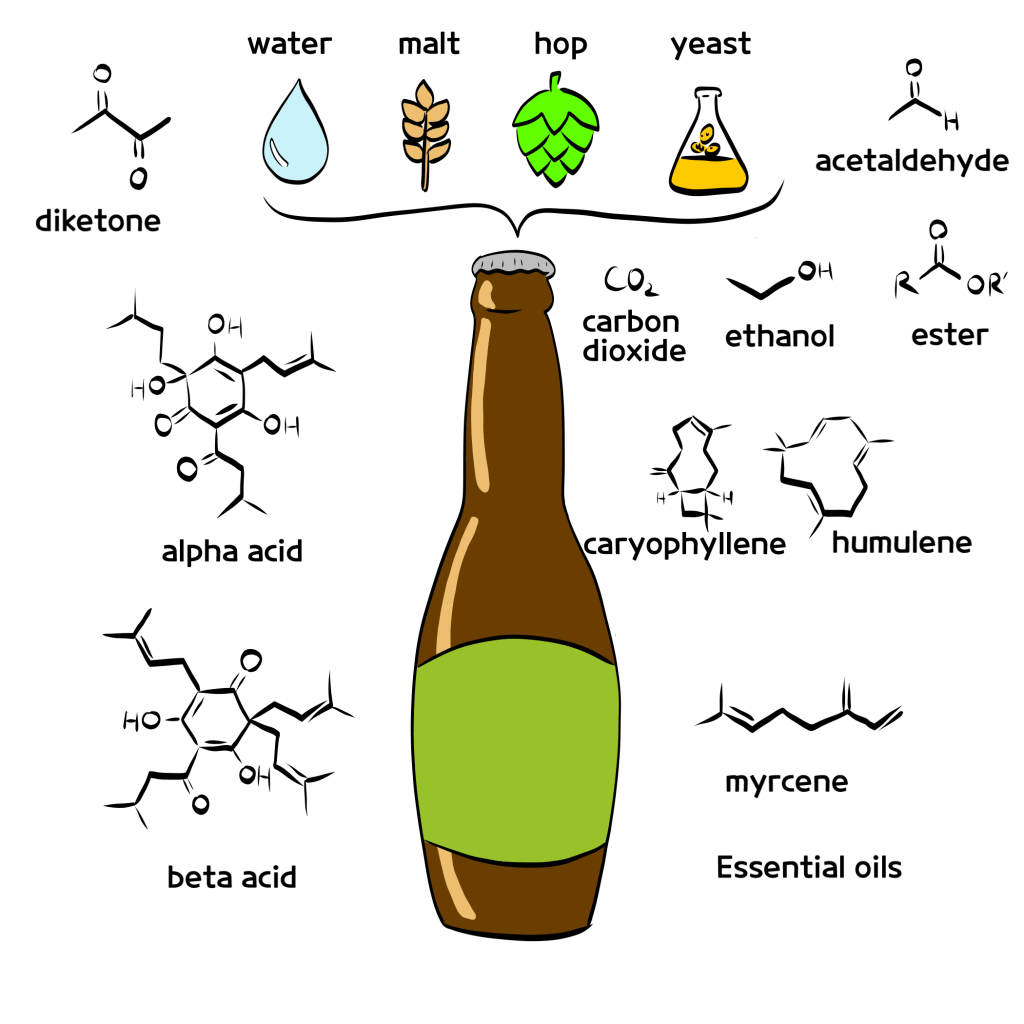
Hops, the flowers of the hop plant, add a distinctive flavor and aroma to beer. The first documented use of hops in beer dates back to the 9th century. Today, hops are used in all beers. Hops contain alpha acids, beta acids, and essential oils, which contribute to the beer’s aroma. The most important alpha acid molecule is humulone, which isomerizes during the boiling of wort, imparting a bitter taste to the beer. Beta acid lupulone oxidizes during fermentation, adding a different kind of bitterness. Around 250 essential oils have been identified in hops, with myrcene, humulene, and caryophyllene playing significant roles in beer aroma. These volatile compounds tend to evaporate during brewing, so hops are added after fermentation or by various other methods to enhance the beer’s aroma.
The wort boiled with hops is cooled to a temperature suitable for yeast addition. The cooled wort is then fermented in tanks by yeast. Yeast breaks down sugars in the absence of oxygen to obtain energy, producing ethanol and carbon dioxide as byproducts. I repeatedly emphasized the phrase “without oxygen” when discussing fermentation. Humans breathe to intake oxygen, which is used to produce ATP, the final energy molecule from glucose in cells. The byproducts are carbon dioxide and water. Without sufficient oxygen, the brain cannot break down glucose to obtain energy, posing a threat to survival. Yeast, on the other hand, breaks down glucose without oxygen, producing ethanol and carbon dioxide as byproducts. These two molecules dissolve in water, creating beer. Ethanol dissolves to make the beverage alcoholic, while carbon dioxide creates carbonation.
Traditionally, beer yeast is classified into ale yeast and lager yeast. Ale yeast (Saccharomyces cerevisiae), used for brewing ales, ferments at the top of the wort. It typically ferments at warmer temperatures (generally 59 – 77°F) and takes about 2 – 3 weeks. Lager yeast (Saccharomyces pastorianus or Saccharomyces carlsbergensis), used for brewing lagers, ferments at the bottom of the wort. This bottom-fermenting yeast ferments slowly over 1 – 6 months at lower temperatures, around 41 – 50°F. During the fermentation process using ale yeast, compounds such as esters, which produce fruity aromas, as well as small amounts of acetaldehyde and diacetyl, are formed through reactions involving ethanol, organic acids, and fatty acids. These compounds give ale its characteristic fresh and fruity flavor. Lager yeast, fermenting at relatively lower temperatures, produces fewer of these compounds, resulting in the cleaner taste of lager compared to ale.
After primary fermentation, the beer undergoes a maturation process known as secondary fermentation or conditioning. This stage can enhance or remove certain flavors and typically lasts from a week to several months. During maturation, any remaining fermentable extracts can undergo secondary fermentation at low temperatures using residual yeast. Additional yeast may also be added to ferment the remaining sugars, which can increase carbonation due to the extra production of carbon dioxide. Sometimes, carbon dioxide is artificially injected to achieve the desired level of carbonation.
The finished beer is either sold as draft beer after simple filtration or is bottled or canned following filtration and pasteurization for distribution. Draft beer, containing a small number of yeast or microorganisms, can spoil over time. To prevent this, pasteurization is often used to deactivate the yeast and ensure the beer remains stable for a longer period.
References
- Mysels, J. Opioid Manag. 2010 6, 445
- https://www.chemsafetypro.com/Topics/CRA/acute_toxicity_ld50_lc50.html
- https://www.therecoveryvillage.com/alcohol-abuse/
- Chiara, Alcohol Health Res. World. 1997, 21, 108
- Cervera-Juanes et al. Mol Psychiatry. 2016, 21, 472
- https://www.drugabuse.gov/drug-topics/alcohol
- Palmer, (2017) How To Brew: Everything You Need to Know to Brew Great Beer Every Time, 4th Ed., Brewers Publications
- Hornsey, (2003) A History of Beer and Brewing, Royal Society of Chemistry
- Olaniran et al. J. Inst. Brew. 2017, 123, 13
- Devitt, 500 years ago, yeast’s epic journey gave rise to lager beer, https://news.wisc.edu/. 2011. 08. 22.
- Stack, A Concise History of America’s Brewing Industry, EH.net
- Gajanan, How to Talk About Beer Like a Pro, Time, 2018. 04. 07
- https://beerandbrewing.com/dictionary/tUHp3R5egg/
- Ting & Ryder, J. Am. Soc. Brew, Chem., 2017, 75, 161
- BYO Staff, Using Roasted Barley: Tips from the Pros, byo.com, 2004. 01
- https://www.simpsonsmalt.co.uk/blog/malt-production-process-roasting/
- Carlin and Rosentha, (1998) Food and eating in medieval Europe, Hambledon Press
- Mitchell and Herlong, Annu. Rev. Nutr., 1986, 6, 457
- Zelman, The Truth About Beer, webMD, 2014. 08.
- Hobson and Maughan, Alcohol Alcohol., 2010, 45, 366
- Cuzzo and Lappin, Vasopressin (Antidiuretic Hormone, ADH), StatPearls [Internet], 2019
- Chiba and Phillips, Addict. Biol, 2000, 5, 117
- Fugelsang and Edwards, (2010) Wine Microbiology, 2nd Ed., Springer Science and Business Media
- Adams, The Science of Winemaking Yeasts, Sevenfiftydaily, 2018. 06. 06.
- Remize et al. Yeast, 2003, 20, 1243
- Russan, The Science of Tannins in Wind, SevenFiftyDaily, 2019. 02. 07.
- Rovner, C&En, 2006, 84, 30
- Robles et al. TrAC-Trends Analyt. Chem., 2019, 120, 115630
- Hines, These Are the Chemical Compounds That Make Wine Taste So Good, Vinepair, 2017. 09. 24.
- Corliss, Is red wine actually good for your heart?, Harvard Healthy Blog, 2018. 02. 19.
- Panesar (2014) Biotechnology in Agriculture and Food Processing: Opportunities and Challenges, CRC Press
- Bang et al. Korean J. Food Cook Sci., 2016, 32, 44
- Takahashi & Kohno, PLos One, 2016, 11, e0150524
- https://en.sake-times.com/learn/the-science-of-sake-aroma
- https://thesool.com
- Casey & Ingledew, Crit. Rev. Microbiol., 1986, 13, 219
- Jin et al. Trends Food Sci. Technol. 2017, 53, 18
- Karlsson & Friedman, Sci. Rep., 2017, 7, 6489
- Tsakiris et al. J Sci Food Agric 2014; 94: 404
- http://www.snuh.org/health/compreDis/OT01/6.do
 Leo & Leah
Leave a comment