
Fruit juice is generally considered healthy, especially compared to carbonated drinks. Many studies, media outlets, and government agencies have highlighted the excessive sugar content in carbonated drinks and have advocated against the consumption of sugary drinks, particularly for adolescents. However, as discussed in “Soft Drinks: Health Risks, Sugar Content, and Addiction Factors,” fruit juices also contain significant amounts of sugar. Although fruit juices generally have slightly less sugar than carbonated drinks, some types can have even more. Both carbonated drinks and fruit juices contain 20 – 26 g of sugar per 8 oz serving, providing about 110 calories. I personally believe that the sugar content in carbonated drinks might have been developed to match the levels already present in fruit juices. Because of this high sugar content, there are critical views against the belief that fruit juice is inherently healthy.
So, are fruit juices really not a healthy drink? Why were they initially considered healthier than carbonated drinks? To understand this issue, we must first examine the manufacturing process and components of fruit juice.
Drinking the juice of fruits can be traced back to the history of wine. It is easy to imagine people drinking grape juice before it ferments into wine. In 1869, Welch, a dentist, sterilized and sold grape juice in sealed bottles using a water bath, which is considered the first commercial fruit juice. The first modern juice extractor, the Norwalk machine, was developed by American entrepreneur Walker. It operated by crushing fruits and extracting the juice, with Walker believing this method could retain the nutrients in the juice. Notably, both Welch and Walker filtered out the fiber and seeds using cloth after extracting the juice. The current method of making fruit juice is similar: washing the fruit, peeling, cutting, mashing, and then extracting the juice. The extracted juice is filtered to remove fiber and other residues, sterilized, and packaged. The main difference between eating fruit and drinking juice lies here. Eating fruit provides a sense of fullness due to the fiber, preventing overeating. For example, studies have shown that eating an apple before lunch reduces overall calorie intake (fruit + meal), but drinking apple juice does not significantly reduce calorie consumption.
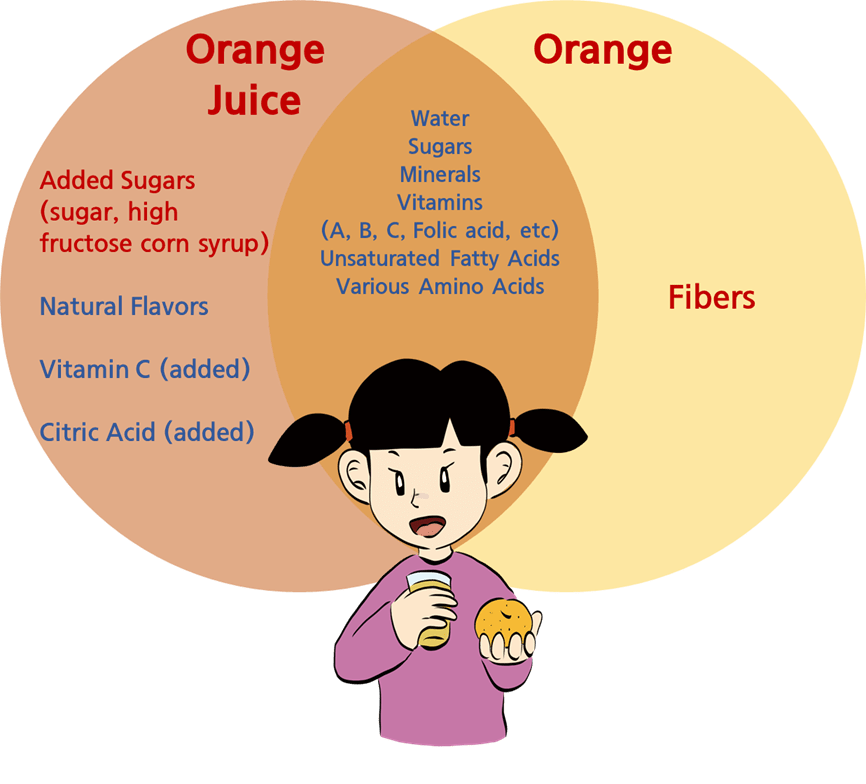
In addition, both fruits and fruit juices are rich in vitamins, minerals, and various polyphenols. Except for vitamin C and fiber, a half cup (4 oz) of 100% fruit juice contains as much iron, potassium, magnesium, and other vitamins and minerals as the same amount of fruit. This is a key difference between carbonated drinks and juice. Without artificial additives, carbonated drinks lack these nutrients. However, the benefits of these nutrients are maximized with just one glass of juice a day. Similar to carbonated drinks, the issue with juice arises when consumed in excessive amounts. As previously mentioned regarding carbonated drinks, the WHO recommends that adults keep their daily sugar intake below 50 g and minors under 18 limit their intake to 25 g per day. One or two glasses of juice a day can be beneficial for children without causing harm.
When purchasing juice from the store, you might notice a difference in taste compared to freshly squeezed juice. This is due to the reaction of the aromatic compounds, which give fruit its unique flavor, with oxygen in the air during processing (oxidation) and changes during sterilization. Additionally, the process of removing dissolved gases from the juice to prevent oxidation during distribution also affects the taste. For these reasons, many commercial fruit juices contain various food additives besides the fruit juice itself. Additives like vitamin C or tocopherol are sometimes added, and citric acid may be included to enhance the tangy flavor. Different companies add different additives under the name “natural flavors” to enhance the fruit’s original aroma. The taste and aroma of orange juice, for instance, can vary by brand due to these additives. To enhance sweetness, additional fructose, sugar, or high-fructose corn syrup may be added. Many fruit juices sold in the US are made by concentrating the juice three- to six-fold during production and then diluting it with purified water to the final concentration. Previously, if the concentration of juice reconstituted from concentrate exceeded that of the original fruit juice (100% fruit juice), the additives did not need to be listed. However, since January 2020, all food additives must be disclosed.
The sugar content in beverages continues to be a point of concern. Carbohydrates are one of the three major nutrients essential for our survival, so why is there so much caution about sugar, a type of carbohydrate? Sucrose, a disaccharide, is quickly broken down into glucose and fructose in the body, which can be immediately used in metabolic processes. Glucose is used immediately as an energy source, while fructose is converted into glucose or stored as fat. In ancient times when food was scarce, sugar was a valuable component that could quickly provide energy and aid survival. Sugar is ingrained in our brains as a component that improves mood through its sweet taste. When we consume sugar, our brains release an excess of dopamine, providing immediate reward and encouraging consumption. The problem is that our bodies are not designed to handle excessive amounts of sugar, leading to health issues when consumed in large quantities. Excessive sugar intake increases the risk of obesity, type 2 diabetes, liver failure, kidney disease, hypertension, and various chronic diseases. The danger of chronic diseases lies in their often asymptomatic development and the difficulty of treatment once they manifest.
From carbonated drinks to fermented dairy products, various dairy beverages, coffee, tea, and fruit juices, it is clear that these beverages enrich and brighten our daily lives. Some of them contain healthful ingredients. However, all these drinks include active components like sugars or caffeine, which interact with our bodies. When consumed in moderation, they can contribute to health, boost energy, or provide a refreshing feeling. Yet, excessive consumption can lead to various side effects. Despite this, there are no significant societal controls over these beverages, likely due to an implicit agreement that individuals can manage their consumption.
In the next chapter, we will discuss a substance that has numerous side effects and is controlled by social regulations, yet has evolved as diversely as common beverages alongside human civilization: alcohol. We will explore it at the molecular level.
References
- Walker et al. Nutrition, 2014, 30, 928
- Caroll et al. Seriously, Juice Is Not Healthy, the New York Times, 2018. 07. 07.
- .Morris, HortTechnology, 1998, 8, 471
- The Atlantic, The Man Who First Juiced by Sarah Laskow, Nov. 20, 2014
- Appetite. 2009 Apr; 52(2): 416–422)
- Clemes, Adv Nutr. 2015 Mar; 6(2): 236S–243S.;
- Healthline, Is Fruit Juice as Unhealthy as Sugary Soda? by Alina Petre, Dec. 13, 2019
- Myers, The Truth About Store-Bought Orange Juice: It Doesn’t Actually Taste Like Orange Juice, The Daily Meal, 2017. 04. 06.
- Johnson and Gower, (2008) The Sugar Fix: The High-Fructose Fallout That Is Making You Fat and Sick, Rodale Press
- Lieberman, (2013) The Story of the Human Body: Evolution, Health, and Disease, Patheon Books
- Business Insider, An Evolutionary Explanation For Why We Crave Sugar by Spector, Apr 25, 2014
 Leo & Leah
Leave a comment