
We eat and drink every day. Eating and drinking are always ongoing tasks. All living beings, including humans, obtain the materials and energy to sustain life through food. Continuing life and reproduction, in other words, survival, are instincts of all living organisms. Although it is something that is always done, there is nothing as important as eating and drinking. Even if we say that the evolution of life resulted from effective food gathering, it is not an exaggeration to say that consuming food is crucial for living organisms. The first unicellular organisms were passive and had random movements. At the cellular level, the development of sensory and motor organs and the ability to collect information and perform directional movements were for more efficient food gathering.
I don’t remember when or where I read it, but I have come across the phrase “you are what you eat” before. When I was an undergraduate student, always short on time and money, I took it lightly, thinking of it as a phrase that meant, “Let’s eat fresh and well-balanced food and stay healthy.” In fact, when I survived on fast food that was cheap and readily available every day, I sometimes regarded it as a very luxurious phrase. During the early days of my social life, I felt this phrase could have social and economic significance beyond the simple meaning of nutritional balance. When I was a graduate student and later as a postdoctoral research fellow, I realized that my social and economic standing could be reflected in the food I chose when dining out with my wife. This was because I consistently opted for the most affordable items on the menu. Even after I started earning income from my job, the habit of choosing the cheapest item on the menu was hard to change for a while. For humans, food is no longer a “small reward for actions” obtained through difficult gathering or hunting processes to maintain life. Food has become a part of social culture, including political, economic, and religious factors. In capitalist society, it is also used as a means of economic gain.
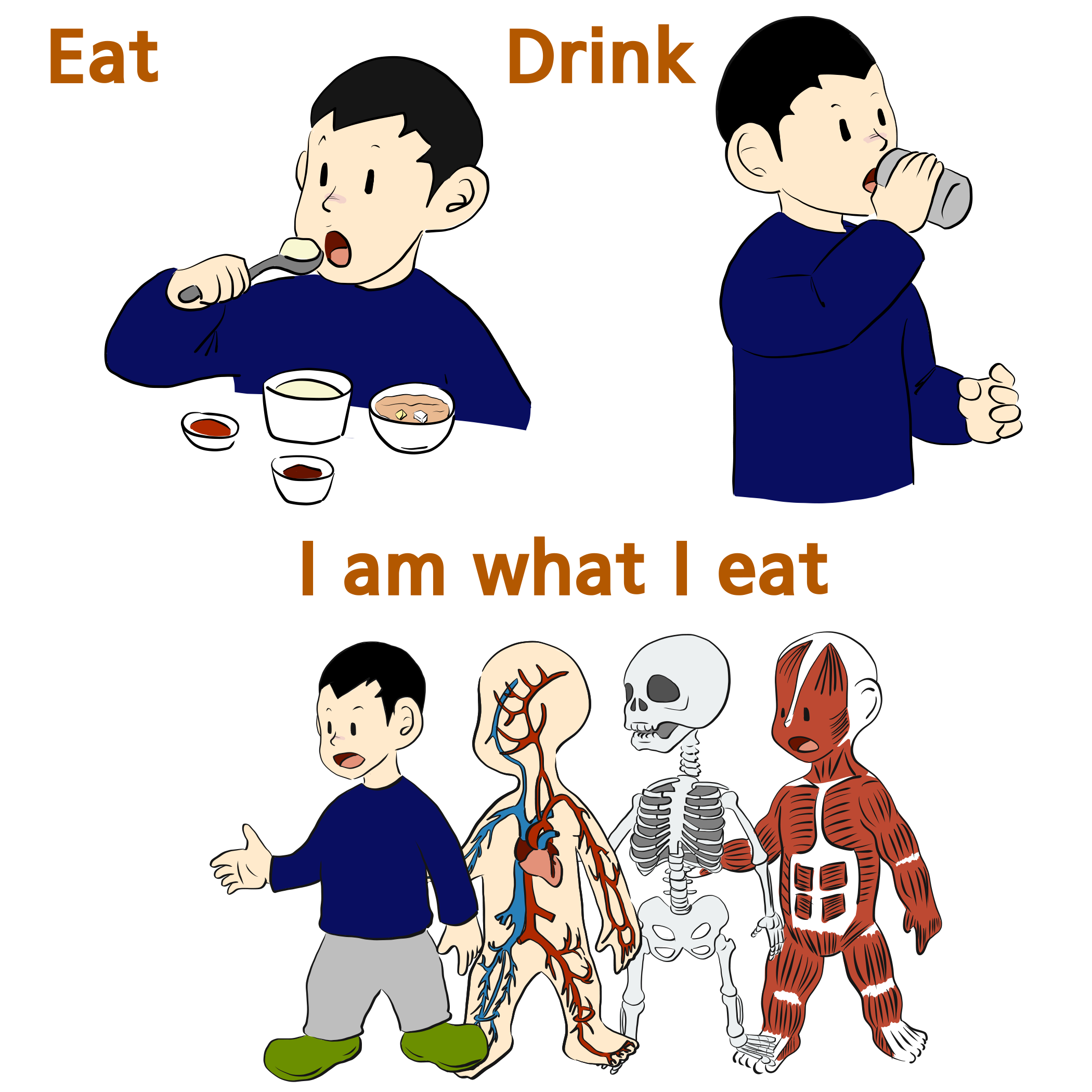
A chemist studies all substances at the molecular level that exist in the world. From this perspective, food is a fascinating research subject. The pleasurable taste is enhanced by intricate flavors and captivating aromas in food. These results come from the complex interactions of various compounds within the food. These compounds interact with the receptors in our nose and tongue. These receptors are responsible for our sense of smell and taste, respectively. These compounds act as chemical markers, providing assurance that the food we are indulging in is both safe and delicious. After consumption, food is broken down by various enzymes and then reassembled into the molecules needed by the cells of different organs, ultimately serving as the building blocks of our bodies (becoming our bones, flesh, and blood). Additionally, the energy carried by the molecules in our food allows us to engage in physical activities (work) and maintain our body temperature (keeping us warm). From the perspective of a chemist, everything that happens within our bodies as a result of consumed food is a chemical reaction.
To survive and obtain essential nutrients, we must eat food. Enjoying expensive, rare, and delicious cuisine is undoubtedly a wonderful experience. However, consuming such foods does not guarantee our health. Nowadays, we do not eat just to stay alive, and we do not eat solely to show our social status. Eating for the purpose of living a healthy life is likely more suitable for us in modern society. So, what foods are truly healthy for us? Can we trust that the foods we hear are healthy truly? Let’s examine how often we eat and drink in our lives. We will do this from the perspective of a scientist who does not engage in economic activities related to food.
References
1. Glasgow, (2018) Minimal Selfhood and the origins of consciousness, Wurzburg University Press
 Leo & Leah
Leave a comment