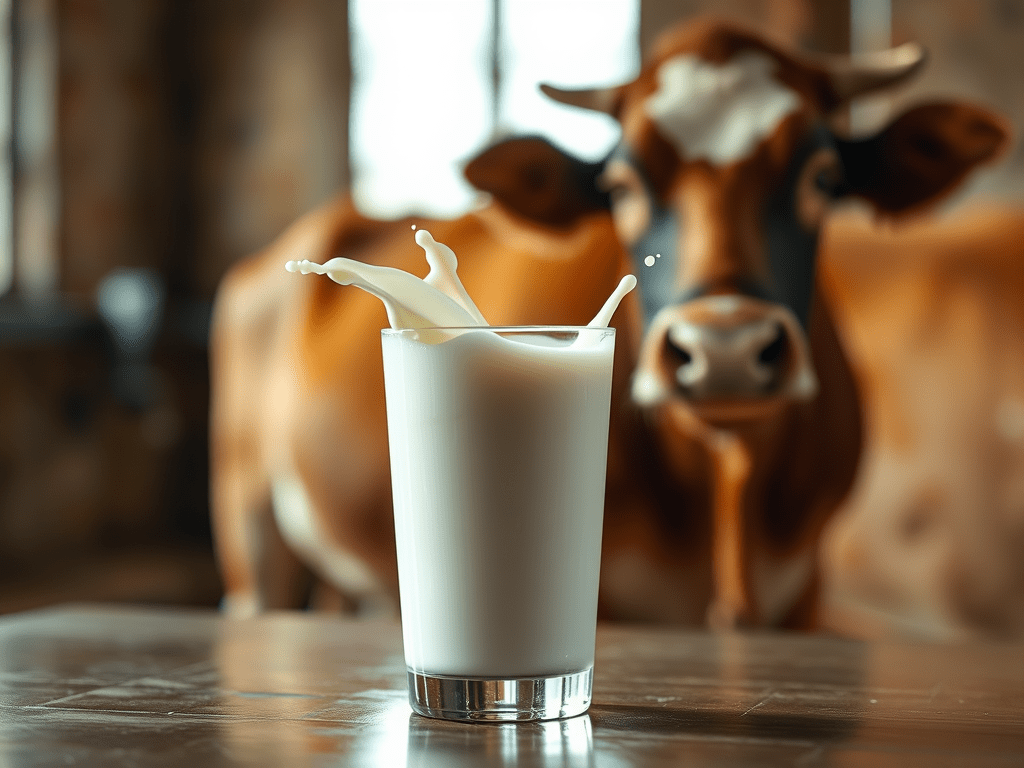
It would be difficult to discuss beverages without mentioning dairy-based drinks. In fact, not just beverages but a wide variety of foods contain milk. Milk is considered by many to be a healthful drink. Milk produced by cows essentially contains more than 3% of each of the three major nutrients (about 3% protein, about 5% carbohydrates, and about 3% fat). Additionally, it contains various vitamins (A, B1, B2, B12, D, etc.) and minerals (sodium, calcium, phosphorus, etc.). Of course, the most abundant component is water (about 88%).
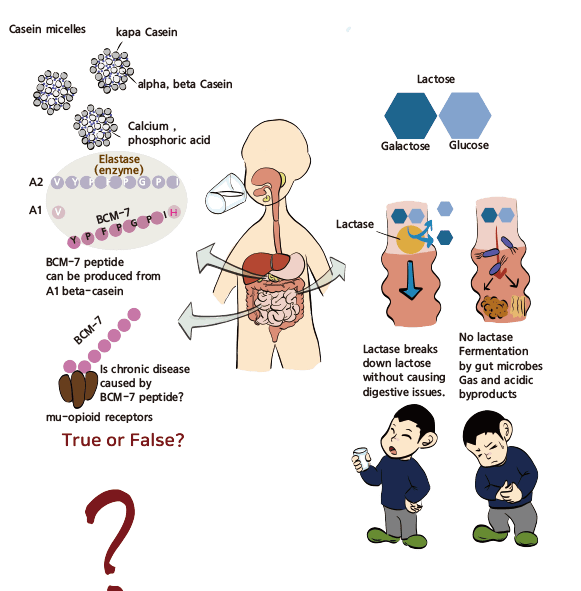
The most abundant protein in milk is casein, which constitutes more than 80% of the protein in cow’s milk. Casein is an acidic protein and is one of the reasons why milk has an acidic pH (6.7 to 6.9). Casein is also a primary factor, along with milk fat, which makes milk a colloid mixture. As previously explained, organic substances do not exhibit purely hydrophilic (water-attracting) or purely hydrophobic (water-repelling) properties. Substances that contain both hydrophilic and hydrophobic properties within a single molecule are called surfactants. A common example of a surfactant is soap. The hydrophobic part of soap interacts with grease and oil, which do not dissolve in water, while the hydrophilic part interacts with water, allowing the grease to be washed away. When surfactants are present in water at a certain concentration, they form small spherical aggregates called micelles (approximately 200 nanometers in size). In micelles, the hydrophobic parts gather inside, away from water, and the hydrophilic parts face outward, interacting with water. Milk forms a colloid because the high concentration of casein interacts with calcium and phosphate in the milk to form micelles.
Casein consists of several types, including alpha (αs1, αs2), beta (β), and kappa (κ), with about 30-50% of the protein composed of hydrophobic amino acids. Among beta-caseins, A1 and A2 are the most prevalent forms. Milk usually contains a mixture of A1 and A2 beta-casein. The amino acid sequences of these two proteins differ, leading to the formation of different peptides during digestion. One peptide that can form in our stomach during the digestion of A1 beta-casein is “beta-casomorphin-7” (BCM-7), which does not form from A2 beta-casein. BCM-7 can act in the digestive tract and has been reported to cause allergic reactions to milk potentially. In response to these concerns, A2 milk was developed. A2 milk contains only A2 beta-casein and no A1 beta-casein. However, comprehensive studies on the relationship between A1 beta-casein and chronic diseases have concluded that 1) no significant amounts of BCM-7 have been detected in the bodies of people who consume milk, and 2) there is little evidence linking BCM-7 to the development of the suspected diseases. Additionally, people who have allergic reactions to milk do not show improvement when drinking A2 milk. Therefore, A1 beta-casein is no longer considered a cause of chronic diseases associated with milk consumption. Nonetheless, some dairy companies continue to market A2 milk as a premium product, claiming it is healthier.
Casein protein is also widely used as a food additive, often in the form of sodium caseinate to improve solubility in water. Sodium caseinate is derived from milk protein and is not considered to be particularly harmful or problematic.
In many cases, stomach upsets or allergic reactions after consuming milk are due to lactose. Milk is pasteurized during production (e.g., 63°C for 30 minutes or 72-75°C for 15 seconds), so if there are no issues during distribution or storage, the likelihood of stomach issues due to bacterial growth is low. Lactose in milk is a disaccharide composed of galactose and glucose. Some people say that lactose gives milk a subtle sweetness, though I can’t really tell. Lactose is broken down by the enzyme lactase in the body into monosaccharides, which are then absorbed in the small intestine.
Lactose is present in the milk of all mammals, including human breast milk. After infancy, when milk is a primary food source, the body’s ability to produce lactase may diminish. This is why many adults cannot digest milk. This condition is known as lactose intolerance, and it occurs when undigested lactose is fermented by bacteria in the colon, leading to stomach issues. However, when milk is used to make fermented products like cheese or yogurt, the lactose is broken down into lactic acid during the fermentation process, leaving little to no lactose. As a result, adults who cannot digest milk due to lactose can often enjoy fermented dairy products without any problems. In other words, if the chemical reaction occurs in the stomach, it causes issues, but if it happens before consumption, it’s fine. In Northern Europe, over 90% of adults produce lactase and have no trouble consuming milk directly. In US, lactose intolerance is less common compared to many other parts of the world, but some still suffer from lactose intolerance. For those with lactose intolerance, lactose-free milk is also available.
References
- Bhat et al., (2016) ‘Casein Proteins: Structural and Functional Aspects’ in Milk Proteins – From Structure to Biological Properties and Health Aspects, IntechOpen
- Rashidinejad et al. (2017) ‘Nutrients in Cheese and Their Effect on Health and Disease’ in Nutrients in Dairy and their Implications on Health and Disease, Academic Press, an imprint of Elsevier
- Truswell, Eur. J. Clin. Nutr. 2005, 59, 623
- Thalheimer, Today’s Dietitian, 2017, 19, 10
- Jesnsen et al. Dairy Sci, 1991, 74, 3228
- http://www.seoulmilkblog.co.kr/
- Weinberg, J. AM. COLL. CARDIOL., 2004, 43, 731
- Elhauge, Eur. J. Clin. Nutr., 2018, 72, 249
- https://www.yakult.co.jp/
 Leo & Leah
Leave a comment